Monday, April 23, 2007

"The Spirit of Catalonia", 1.


"The Spirit of Catalonia", editat el 1946, que divulguem pels nostres lectors gràcies a la col·laboració de la família Trueta.


• 1 •
Astride the Pyrenees
THE ANCESTORS OF THE PEOPLE DEALT WITH IN THIS
book were Pyreneans, Iberians, Celts, Greeks, Romans and
Visigoths. They lived in the southern part of Gaul and northern
part of the Iberian peninsula: that is, the large area between the
Loire in the North, the Ebro in the South, the Alps in the East, and
the Cantabric Sea in the West. Its geographical nucleus was the
town of Narbonne, centre of the Roman administration for more
than five centuries; in the extreme South was the town of Tarraco,
the capital of the Roman province of Tarraconensis. Later, when
the barbarians of the North invaded the decrepit Roman Empire,
they made Toulouse—farther West—their capital.
As for the more remote ancestors of this people, we know that the
races which migrated from Africa, Europe, or Asia always spread
very evenly over the South of Gaul and the North of the Iberian
peninsula. In fact there was no geographical obstacle to their great
invasions; this calls for an explanation, since the reader may think
of the Pyrenees as a barrier between the middle and the southern
parts of the area with which we are concerned. The Pyrenees may
be divided into three sections: the centre of the range which is very
difficult of access, and the two sections at the ends with passes
open even in the coldest winter. Towards the Mediterranean end of
the mountains, there are four routes linking the plains on either
side. Iberians, Greeks, Celts, Carthaginians, Romans and Goths—
none of them were ever checked by the Mediterranean Section of
the Pyrenees; rather is it probable that the passes lured them on to
the plains
2
The Spirit of Catalonia
beyond. But the middle and most of the western section are
different: throughout history they have acted as a confining wall,
partly because the passes through them are few and difficult, but
principally because of the warlike nature of the Basques, who have
lived there from prehistoric times. The Basques, with the
mountains to aid them, stopped the Romans with that same spirit
with which, many centuries later, they fought Charlemagne's
army—a struggle which inspired the Chanson de Roland and other
poems. It would not be an exaggeration to say that the unique
topography of the Central Pyrenees has preserved to our own day
one of the few prehistoric human stocks in Europe; and it is to the
mountains that the Basques are indebted for the preservation of
many of their ancient characteristics, physical, mental, and moral.
The existence of the Basques all along the high ranges of the
Central-Western Pyrenees is mainly responsible for the clear-cut
difference between Frenchmen and Spaniards of today; as time
passed the Basques of the plains have been strongly influenced by
both, but most of the mountaineers have remained purely Basque.
This varying accessibility of the mountains has conditioned the
history of the Iberian peninsula and has made its inhabitants what
they are today. The simple view—which, like every simple
impression, tends to stick in our minds—that the areas represented
by modern France and Spain are well defined by nature, is
incorrect if applied to the inhabitants. And it is equally misleading
if applied to the climate and other factors of their environment; in
fact, climate and natural surroundings are very similar throughout
both areas north and south of the Pyrenees. Thus, it is only natural
that the older inhabitants of the zone between the rivers Ebro and
Loire and the Alps and the Cantabric Sea had very similar
characteristics. If anything, in ancient times the Ebro was
considered a better boundary than the Pyrenees;
3
Astride the Pyrenees
it was the frontier between the Carthaginians and the Romans,
and later between Christians and Mohammedans. In later days,
the southern limit of the zone occupied by this people was
displaced to the south of the Moorish kingdoms of Valencia and
Denia.
Much study has been devoted to the question of Greek influence
in the Western Mediterranean after the foundation of the
Phocaean colonies of Massalia—Marseille (seventh century
B.C.), Rhoda—Roses, Emporion— Empuries, and
Hemeroskopeion—Denia: Greek influence on the later
characteristics of the people was important even if it cannot be
compared to that of the Romans. The term “influence” means not
only the grafting of ideas and habits; it is used here rather in a
biological sense. The Greeks and particularly the Romans
moulded the people of this zone and imparted to them their own
characteristics to such an extent that the latter called a very large
part of that area 'Provincia', as it were par excellence.1 Later it
was named Septimania because the Seventh Legion was stationed
at Béziers, another of the great towns of Roman Gaul.
During the fifth century A.D. these lands were occupied by the
Visigoths, after being ravaged by the Vandals, Cimbris, Teutons,
and Ambrones. Of all the barbarian tribes the Goths—Visigoths
and Ostrogoths—were the most highly civilized, and the only ones
to be Christianized at that early date (though they adhered to the
Arian heresy), and to possess an alphabet adapted to their own
language.2 They were easily absorbed by the more highly
developed indigenous civilization, and after a relatively short
time, in spite of being the ruling aristocracy, they mixed with the
native population; the southern part of the country then changed
its name to 'Gothia', or land of the Goths. The Roman traditions,
laws and administration were so deeply rooted that for a time two
parallel ways of living developed side by side;
4
The Spirit of Catalonia
on the one hand we find the newly-imported aristocratic manners
of the leading families holding a personal power purely Teutonic
in nature; on the other, a persistency of the old Roman
Communes with their civilian intercourse. But both the new and
the old social systems were rapidly changing with the changing
times.
At the beginning of the eighth century, the stabilization of this
society was interrupted by the sudden arrival of more barbarians,
this time from North Africa. At the first blow they defeated the
Christian army in the south of the Peninsula, and the Saracens
spread, in the course of a year or two, almost to the northern
confines of the Peninsula without meeting any serious opposition
except for the courageous resistance of the people of Mérida. The
feature common to all the previous invasions was then repeated,
but this time there was something more, which had a telling
effect on the making of modern Spain. The population of the
Peninsula behaved in the following ways.
I. The Mediterranean people of the Tarraconensis emigrated en
masse to the north of Septimania as far as the region of central
France called Limousin. The easy crossing of the mountains now
became a source of deep terror. After the Mohammedans had
swamped without a fight almost the whole of the Iberian
peninsula, the old imperial town of Tarraco, proud of her ancient
prestige, tried to resist the invaders. After a bloody struggle it was
taken, levelled to the ground, and its inhabitants massacred. The
same fate befell Manresa, Casserres, Cardona, Ausona and
probably the Greek Empuries further north. This seems to have
been more than the rest of that part of the Peninsula could stand.
Barcelona and Girona were occupied without a blow, and the
towns and villages were abandoned by a great proportion of the
Christian population, who fled to Gaul.3 Only a few people,
probably almost all of them Jews, remained in
5
Astride the Pyrenees
Barcelona; they were the population which the Christians found
when they recovered the city ninety years later. We have some
knowledge of what these people felt when their city was
reconquered by the Christians: it seems they received the
newcomers as enemies rather than as brothers, which suggest that
very few if any Christians were among them.4
2. The Basque people behaved as they had always done: they
retired to their closed valleys in the mountains and continued the
fight, supported from behind the protecting barrier by the Basques
living on the northern slopes of the Pyrenees. They were never
conquered, and thus they viewed the Moors from a distance, but
with the same vigilance with which, in centuries gone by, they had
viewed the Celts and the Romans.
3. Near the Cantabric coast there runs a long range of high
mountains which orographically are a continuation of the
Pyrenees; and there, people from the south and centre of Spain,
especially aristocratic families, found refuge from the Moors.
With their backs to the sea—an impassable barrier to a people
who were not sailors— they continued the struggle in the
mountains, and at length they began to recover their lost lands in
a slow, southward movement known in Spanish history as the
'Reconquista'. This was completed almost eight centuries later,
when the Moorish kingdom of Granada fell in 1492.
4. The people of the Atlantic coast, it seems, either stayed where
they were or retreated to the north-west corner of the Peninsula.
They were mostly of Celtic origin and at the time of the Teutonic
invasions of the Peninsula they had been conquered by the Sueve
tribes. This region was called Galicia, and from its people on their
southward march there arose, well within the twelfth century, the
Portuguese nation. Even nowadays, Galicians and Portuguese
speak two derivative forms of
6
The Spirit of Catalonia
the old Gallego language. The affinity of the Portuguese and the
Spaniards has been recognized from early5 times. The diverse
behaviour of these Peninsular peoples at the time of the Moorish
invasion lies at the root of their ensuing diversity, which has
persisted almost unchanged throughout the vicissitudes of history.
The people sheltering in the Cantabric mountains—Castilians or
Spaniards —and those compressed by the Saracens into the northwest
corner of the Peninsula—Galicians and Portuguese —moved
in two parallel lines until they reached the southern limits of the
Peninsula. Thus the central and western parts were recovered by
their original populations or at least by people of the same stock
as the pre-Mohammedan inhabitants. The central people spoke
the rapidly evolving variety of Romance now known as Castilian
or Spanish; the people of the Atlantic lands spoke their Galico-
Portuguese language, as they do now. The Basques descended to
the plains where they had previously lived since prehistoric times,
and stayed there. They had recovered the country where their
ancestors lay buried, and there they have remained, in almost
exactly the same places, to the present day.
The reconquest of the lands deserted by the Christians of the
Mediterranean coast was undertaken by the people of Southern
Gaul. Once across the Pyrenees, the Moors had continued
northwards and taken Narbonne; their advance was at last arrested
when the Frankish Charles Martel, duke of Austrasia, defeated
them. The decisive battle was fought between Poitiers and Tours
in 732. From that day two simultaneous successions of attacks
compelled the Saracens to go back whence they came. One of
these was a movement of the Peninsular peoples only (Portuguese
and Castilian); the other had a Continental origin: Gallic,
Frankish, Gascon (see map on p. 7). This movement liberated
Narbonne in 759, and then, under the supreme command of Louis
'le Debonnaire',
7
Astride the Pyrenees
King of Aquitaine, and with soldiers from Aquitaine, Gascony,
Septimania, Burgundy and Provence,6 the Christian army crossed
the Pyrenees, and liberated Girona in 785—or shortly before—and
Barcelona in 801. Louis 'le Debonnaire' brought with him to the
newly liberated regions soldiers of the same origin and language,
customs and feelings, being united by a common purpose of a
religious and—if this may be said referring to people of the eighth
century—a patriotic nature. The newly-recovered parts were
placed under a common administration, and lands were given to
the soldiers, at first in a fief for life—benefici, and later in
perpetuity—aprisió.
8
The Spirit of Catalonia
Families from the northern side of the Pyrenees settled on the
southern slopes and in the valleys, and with them they brought the
ties which connected these lands more than ever before, this
linking again the populations from Nice and Limoges to Barcelona.
The newly-regained country was more than an expansion of
Southern Gaul; it was the melting-pot in which the regional
differences between the peoples of Southern Gaul were fused into
a national type. The language they spoke was closely akin to the
various dialects of Southern Gaul—all of them of a common
origin, and known as Languedoc, Provençal, or Limousin (see map
above); it had the advantage of preserving the most vivid
expressions from the various dialectal forms.7
9
Astride the Pyrenees
The people of Southern Gaul had, under the Romans and probably
also under the Goths, succeeded in preserving self-government,
their own laws and their own magistrature; Northern Gaul—the
parts later to be occupied by the Franks—did not obtain these
rights before the twelfth century.8 In the eleventh century the
citizens of the towns in which Langue d'Oc was spoken— in the
area commonly called Provence, although it is very much larger
than the Provence of today—constituted a separate social class
distinct from the nobility, from the clergy, and from the serfs. They
were called bourgeois, a term which occurs in the Catalan law
Usatges in 1060, in Carcassonne in 1107, in Montpellier in 1113,
and in Béziers in 1121; the towns nominated consuls for their own
government.9 Soon the bourgeois of the villages formed militias to
assist the armies of the nobility in their wars; this institution,
although modified by centuries, still exists in Catalonia under the
name of sometent. Narbonne was made the religious centre, and
Barcelona became the political pole around which the national
consciousness was forming. Aix-en-Provence, Montpellier and
Toulouse were the complementary focus from which light was
shed over science, art, and politics. Thus it may be said without
exaggeration that by the twelfth century a new civilization had
emerged in Europe, for the first time after the collapse of Roman
society. It had taken more than six hundred years, but this
laborious process of gestation was now completed, and humanity
began to move upwards again. All conditions for a prosperous life
were at hand: among them a fertile land favoured by one of the
mildest and most equable climates in Europe; a geographical
situation which made the country between the Ebro and the Loire
the link joining the North with the South and the Mediterranean
with the Atlantic; numerous wealthy cities, in which society
increasingly resembled the ancient Roman pattern; good
communications;
10
The Spirit of Catalonia
Mohammedan civilization developing in the neighbouring Spanish
State;10 a refined aristocracy which protected the Arts, and a rich
and energetic middle class composed of merchants and sailors,
which provided the sources of the nation's wealth. Commemorating
the Gothic domination on both sides of the Pyrenees, a large part of
that region in which the Langue d'Oc was later spoken was called
Gothia or land of the Goths, and according to some authorities it
was from this that the word Gothalaunia originated. An alternative
view is that it was derived from a settlement of people from the
Gallic Champs Cathalaunis. As early as the beginning of the
twelfth century, the name was used in its modern form, Catalonia,
though then applied almost exclusively to the southern side of the
Pyrenees. Thus Catalonia may be said to be the region where all
the various characteristics of the Provençals became concentrated
and, in many spheres, intensified.11
Unfortunately, the seeds of disintegration were also to be found in
this early Provençal society. Among them was corruption in the
monastic orders and religious hierarchies, which many were
allowed to join not for their conduct, piety or wisdom, but merely
as followers of a profession in which the poor could find
subsistence and the rich a source of power. Another danger for this
young society was the fact that many of the aristocrats soon
neglected the arts of war, preferring patronage of poets and singers
to the exercise of their military prowess against the
Mohammedans. This criticism however does not apply to the
people who were more directly under the rule of the counts of
Barcelona—the Catalans; they had to fight continually in order to
drive back the Saracens from the lands they had conquered at the
beginning of the eighth century. The preponderance of Troubadour
poetry in the northern part of the country over its southern part,
that is, of Provence over
11
Astride the Pyrenees
Catalonia, is probably due to the fighting kept up by the Catalans.
From the time of the reoccupation by the Christians of the country
from Narbonne to Barcelona, the feudal authority was held by the
kings of the Carolingian dynasty. But in the course of time their
authority dwindled to hardly more than a nominal fief, from which
the earls of Barcelona were freed at the end of the ninth century,
'from Narbonne to Spain', as the Gesta Comitum put it. Some
stigmata of the former dependency still remained in the names of
the coins and the dates of the official documents, which were
inscribed and dated
12
The Spirit of Catalonia
according to the reign of the kings of France. In 1112, the Count of
Barcelona became Duke of Provence by his marriage with Dolça
the heiress of that dukedom. This new authority of the House of
Barcelona, extending from Nice almost to the Ebro, marked a
further step in the growth of national consciousness among the
people of the Langue d'Oc (see map on p. 11). In books by
Provençal writers on this period, we find definite expressions of
gratitude to the House of Barcelona for the high development of
Provence under its rule.12
The authority of the House of Barcelona over Southern Gaul took a
more definite shape when, in 1137, the Catalan counts became
kings of Aragon by the marriage of Count Ramon Berenguer IV
with Petronella, heiress to the throne of Aragon.13 From that time
onwards, Provençal was a language not only suited for poetry but
generally spoken at a king's court as well. Toulouse, the great city
of the river Garonne and the only centre resisting the hegemony of
Barcelona, more and more came under its influence; at the
beginning of the thirteenth century its dependency was complete,
when the country was ruthlessly attacked by the Northern
Frenchmen, the descendants of the Franks who had conquered
Northern Gaul in the sixth century.14 The terrible struggle between
the people of Northern and of Southern Gaul marked the end of
Provençal nationality and cut asunder for ever the destiny of a
people hitherto joined as one unit: from that time on, the Pyrenees
have remained a frontier.
The superiority in wealth, culture and refinement of the people of
Southern Gaul roused the envy of the warlike and primitive French
of that time;15 but this alone would hardly have sufficed to disrupt
so large a country, without the causes of disintegration already
mentioned. I have stressed that the most powerful of all was the
state of the Church; but the type of remedy the people tried to
apply to it was even worse. Among an intelligent and
13
Astride the Pyrenees
hard-working people of deep religious feeling, the spectacle of
degenerate priests who practised simony and other irregularities
produced a demand for reformation of these abuses. Rome was
unable or unwilling to meet this claim, with the result that heresy
sprang from the criticism and depreciation of the monks and
priests, and also from the economic development of the
communities.16 It was a merchant from Lyons named Valdo who
principally carried the propagation of the heretical doctrine. His
preaching was not in many points in conflict with the Catholic
dogma; but among other striking doctrines he preached that
poverty was essential in order to carry the Christian Apostolate in
accordance with the will of our Saviour; he and his followers also
spread the belief that taking an oath was forbidden by God and
that, in consequence, no man was entitled to swear an oath to
another man. It will easily be realized that the acceptance of this
doctrine would have brought about a collapse of feudal society,
which was founded on the fief of obligation; and that it would
probably have caused very real harm to a society not as yet
sufficiently developed to be supported by the communities only.
The Roman Church fought the heresy with all her might, and
Valdo and his followers were excommunicated. One of the
excommunicated Valdenses called Duran—H. C. Lea, an authority
on that period, calls him the Catalan Duran of Huesca17 —having
repented of his heresy and returned to the fold of the Roman
Church, asked Pope Innocent III for authorization to organize a
new monastic order whose exemplary poverty, morality, and piety
would serve as a model of Catholic life. Duran's idea was not
brought to a practical realization when, in 1207 he first approached
the Roman authorities, but it was accepted and fully developed
some years later when the Order of St. Francis was founded. It was
probably considered out of place at a moment when religious war
was ravaging the lands of
14
The Spirit of Catalonia
Southern Gaul; the reformation of monastic abuses may have been
considered more proper when complete victory had been won by
the army of the French Crusaders. In fact the Crusade was
preached against another heresy known by the name of an Occitan
town, Albi, where the new sect had made many proselytes, and
from which the terms of Albigensian and Albigenses were derived
and applied to the new heresy and heretics. This heresy was not
very different from that of the Valdenses, but it seems to have been
more popular in character, deriving some influence from ancient
Oriental Manicheism. Unfortunately, most of the contemporary
documents have been lost, and very little reliable information has
been transmitted to modern times, among it the Cansó de Crozada
of Guillem de Tudela.18 However, we know that the common
people of Provence called the priests of the new religion the 'poor
brethren' and the 'bons homens' —an evidence of the exemplary
role claimed by the heretics.
One of the first steps taken against the ensuing religious anarchy,
which threatened the collapse of Catholic authority, was the
Council of Lombers in 1165, where the nature of the heresy and
the dangers of its propagation were defined.19 The followers of the
new religion seem to have been, in general, illiterate persons who
had no established system of faith; the word Albigenses was
applied to them for the first time during the crusade in 1208; a
contemporary description,20 says that 'the false prophets claim to
follow the life of the Apostles, praying without end, walking
barefoot, and praying on their knees seven times, night and day;
they do not allow the use of money and do not eat meat or drink
wine and are satisfied with simple food; they say that alms have no
moral value because nobody should be allowed to possess material
wealth; they refuse the practice of Holy Communion saying that
Mass is useless, and they declare
15
Astride the Pyrenees
that they are ready to die and to suffer the most severe punishment
for their beliefs. They claim that they can perform miracles. There
are twelve principals among them under the direction of one whose
name is Pons.' Only when the admonitions of Rome were
neglected, the great Pope and able politician, Innocent III—
Lothario Conti, a native of Rome—decided to intervene in a more
vigorous way by changing the highly placed hierarchies of the
Provençal Catholic Church, as they were suspected of weakness
towards their heretical fellow-countrymen. The Troubadour from
Marseilles, Folquet—the son of a Genoese family and great friend
of St. Dominic and of King Alfonso VIII of Castille—was made
archbishop of Toulouse, and most of the other Church posts were
given to clergy from France. The bishops of Narbonne (Berenguer)
and of Béziers were dismissed and their successors were 'newlyimported'
men.21 St. Dominic then played the decisive part. He was
a Castilian by birth, born in the village of Calaroga in 1170, near
the town of Palencia. His name was Domingo de Guzmán, and he
belonged to a noble family. In 1203, when accompanying the
bishop of Osma, Diego, to France he became convinced that an
urgent remedy had to be applied to the heresy of Southern Gaul; he
went to Rome and was delegated by Pope Innocent III to preach
against the heretics in Provence, where he remained from 1205 to
1215. This preaching is considered to have been the mission of
Dominic's life; he did his best to restrain the heretics from their
errors, but believing he had failed he suggested to the Pope that,
where preaching had been inefficient, repression and blows might
be more effective. The following words are taken from his last
sermon in Provence: 'For many years have I exhorted you in vain
with gentleness, preaching, praying and weeping. But according to
a proverb of my country, "where blessing can accomplish nothing,
blows may avail". We shall
16
The Spirit of Catalonia
rouse against you princes and prelates, who, alas, will arm nations
and kingdoms against this land . . . and blows will avail where
blessing and gentleness have failed.' St. Dominic's prediction was
to be fulfilled, to the misfortune of the Provençal people.22 From
that time the Order of Dominicans grew out of the little band of
volunteers who had joined Dominic of Guzmán. In 1214 the
nucleus of this institution was formed around Dominic and was
known as the 'Holy Preaching'. In 1215 the archbishop of
Toulouse, Folquet, established Dominic and his followers in a
house and church in Toulouse. Innocent III made the first
arrangements for the foundation of the 'Order of Preachers', but it
was not before Honorius III had succeeded him that the new Order
had full Papal recognition, in 1218. By 1222, the year after
Dominic's death, there were more than five hundred friars and
sixty friaries, divided into eight provinces spread all over Europe.
One peculiarity of the Dominican provinces was that they
followed the old geographic and administrative divisions of the
Roman Empire: that is, Italy, Hispania, Gaul, etc. Lyons, Limoges,
Reims, Metz, Poitiers, Orléans in France; Bologna, Milan,
Florence, Verona, Piacenza and Venice in Italy; Madrid, Palencia,
Seville and Barcelona in the Spanish peninsula; Oxford in
England; Friesach and Prague in the Holy Roman Empire, and
Cracow in Poland had Dominican friaries which as early as 1217
had sprung from the forty friars of Rome and the thirty of Paris.
The original idea of St. Dominic of combining blessings with
blows qualified his order in Spain in later days for the
administration of the Inquisition.23 But side by side with these
intolerant Dominicans, some of the most illuminating minds of the
Middle Ages emerged from this order, among them St. Thomas
Aquinas and Albertus Magnus.
From the national point of view of the Provençal people, the
intervention of St. Dominic and his Order was
17
Astride the Pyrenees
decisive; he gave to Rome, Paris and Toledo, the centres of the
Italian, French and Spanish States (Madrid has now taken the
place of her neighbour, Toledo), the means of coercion against the
intermediate Catalano-Provençal nation. Three centuries later, St.
Dominic's foresight was to be proved again when the complete
extirpation was attempted of the free remains of the Langue d'Oc
people, that is, of the Catalans.
Both the Soldiers of the Cross—the men of France—and the priests
appointed by the Pope or by the Pope's legates, acted with rude
expedition, not only against the heretics but indiscriminately
against all nationals of the civilized Provence, irrespective of age,
sex, or religion. The city of Béziers was defended by its
inhabitants; after being taken by the Crusaders, it was completely
demolished and the whole population, heretic and Catholic alike,
was massacred. Carcassonne, too, suffered terribly, and after it had
fallen into the hands of the French, the Catalan King Pere II
decided to intervene in order to stop the progress of the French
across his country. Pere II had shortly before helped to defeat the
terrible Almohades from Africa, who were a serious threat to the
Christian Kingdoms of Spain after the Moorish defeat of the
Castilian army of Alfonso VIII at Alarcos, in 1195. At the battle
of 'las Navas de Tolosa' in 1212, the combined armies of the
Basques under the command of their king, Sancho the Strong, the
Castilians under Alfonso VIII, and the Catalans and Aragonese
under Pere II, completely annihilated the large Moorish army; this
victory marked the beginning of the Mohammedans decline, from
which they never recovered.
King Pere, knowing that the invasion of his country bore only a
remote relation to the extirpation of an heresy but a very close
connexion with the imperialistic ambitions of the French,
summoned a large army and went to the help of Toulouse. In
Muret, a few miles from Toulouse,
18
The Spirit of Catalonia
King Pere's army was completely defeated by the small army of the
Crusaders under the command of Simon de Montfort (1213), and
in the middle of the fighting the King was killed. The disaster of
Muret marked the beginning of the partition of the Occitan lands
into two parts under two separate powers, French and Catalan for
some centuries and French and Spanish later. The Catalan
hegemony in Southern Gaul began to decline until, less than fifty
years later, the son of Pere II, King James I, signed the
renunciation of his rights to the lands of Southern Gaul, in favour
of the House of France. The treaty of Corbeil, signed in 1258, gave
France the shape it has preserved through history. It also made
Catalonia what it is. From those days, the common interests of the
now divided people have many times been opposed by the
conflicting ambitions of Catalonia and France; the Provençals, as
rivals of the Catalans, were encouraged by France to inhibit
Catalan expansion. But then, as now, Provençals and Catalans had
a similar outlook derived from their common origin and similar
environment. King Jaume I—called 'the Conqueror' because of his
military successes—was more than any of his predecessors a pure
type of the Provençal race. Son of the Catalan Pere II—known as
the Catholic, in spite of his support of the heretics—and of Maria,
Countess of Montpellier, King Jaume was born in his mother's city.
For that reason Montpellier was the only city which remained in
Catalan hands up to the middle of the next century. This also
explains why Montpellier was the university town of the Catalans
and why its incorporation into France in 1349 marked the end of
the great period of that model of a medieval university. The
superiority of Paris reduced Montpellier, in less than fifty years, to
the provincial condition in which it has since remained.

Saturday, February 24, 2007

"he supports Catalan literacy crusades and Catalan independence"


sbject: [josepsort] 2/24/2007 10:34:00 AM
http://josepsort.blogspot.com/

Tidle:

"Barcelona's right-back philosopher out to make world a better place"

Sid Lowe
Wednesday February 21, 2007
The Guardian

A crowd gathers in the sunshine at the Camp Nou, hoping for a glimpse of their heroes - a fleet of luxury cars pulling away to cheering and applause. A BMW here, a Mercedes there, a Hummer, a Ferrari, a Porsche or two ... and a van. Yes, a van. It is not your typical footballer's car, but then the driver is not your typical footballer.
Oleguer Presas rejects suggestions that he's different and is uncomfortable with labels. Sitting in the bowels of the Camp Nou while he explains his beliefs in a soft, thoughtful voice, it is apparent that facile descriptions do him little justice, but there's no escaping the fact that he stands out - and not just because of the beard. Instead, Oleguer stands out because he speaks out.

The Barça right-back is a committed campaigner, an economics graduate who contributes to cultural and political journals with carefully elaborated articles, he supports Catalan literacy crusades and Catalan independence, and dedicated the only goal of his career to a fourteen year old from Sabadell who had been arrested for protesting against the mayor. He is the author of a book called Camí d'Itaca (The Road to Ithaca), which deals with everything from the Franco years to the war on terror and even anorexia.
He is also the author of an article entitled De Bona Fe (In Good Faith), which was published in Directa, a Catalan social journal, and then in the Basque newspaper Berria. In the article, Oleguer questions the independence of the Spanish judiciary, using the ETA terrorist Ignacio De Juana Chaos as an example of the hypocrisy of the system. It is a system he distrusts, right down to its party political representatives, insisting: "No party represents me. I feel closer to civil society than political parties; the only thing they really want from the people is a vote every four years. That's not the democracy I believe in."

Oleguer's article was a reflection on the state of law and De Juana was just one example, but the fall-out was intense. He was portrayed as supporting a convicted terrorist with 25 deaths on his hands. The press attacked him, the former Bolton striker Salva Ballesta said he deserved "less respect than a dog turd", and boot sponsors Kelme dumped him. When Barça visited Valencia, he was whistled and booed with every touch.

Wouldn't it have been easier to keep his mouth shut? "Yes," he says softly, "but life isn't easy. If we want a better world, we all need to roll up our sleeves. It's easy to moan to your friends and then do nothing. The consequences I suffer are nothing compared to what many people go through. What did sadden me, though, was that most didn't actually read the piece. If people engaged in dialogue with intelligence and disagreed, then fine, but they didn't."

And yet Oleguer is realistic enough to recognise that snap judgements are inevitable, that the headlines would focus on De Juana. It is a product, he believes, of a world where superficial imagery triumphs over analysis in wave after wave of information. "I often ask myself why we went to war in Iraq, why people weren't more scandalised by it, why they didn't do more when polls said they were anti-war. That's one of the great questions. But we live in a society where the news is voracious," he says. "There are stories that are hugely important but within a week they're forgotten.

"For me, it's shameful that [Iraq] was destroyed. And now they say: 'Oh, actually, no, there weren't any Weapons of Mass Destruction after all but we're going to stay here a while because there's such disorder'. But, that disorder was created by you! It's clear that there are imperialistic, economic and strategic interests behind the war but the news moves on and everyone focuses on something else. We have to stop and reflect a bit on where we are going, about imposing a more sustainable type of development, with genuine cooperation."

But doesn't football serve the same function, could it not be seen as a modern day opium of the masses? One to which Oleguer contributes? "It is helpful to rationalise the game, but football does matter," he says. "Because people give it importance."

And for Oleguer, nowhere is that more significant than at Barcelona, the club that presents itself as a Catalan flagship, an anti-Francoist resistance force. Oleguer writes in his book that: "When Barcelona win the league, we become the Army of joy finally able to face up to [Franco's troops]. We imagine ourselves halting that pack of tanks, responding to their bullets with song, laughing in the face of the fascist ire."

It might sound far fetched, and Barça's history is far less clear-cut than the official version would have it, but at least with Oleguer there's no shallow lip service to the legend, no ¡Visca Barça, Visca Catalunya! Now, where's my cheque?. "For me, Barcelona is genuinely special," he says. "It is the invocation of a country, representing Catalan identity and culture. Barça was a conduit for a feeling when people could not express themselves and for me it's a dream to be here at such a successful time."


In Good Faith, by Oleguer Presas (translated by Sid Lowe)

Ignacio De Juana Chaos has spent the last twenty years in jail. Reduced according to the penitentiary rules put in place by the previous government, he had been condemned to an 18-year sentence for the crimes he committed. However he remains in jail on remand, pending the final resolution of the case which has been opened against him because of two articles published in the newspaper Gara. The high court [Tribunal de Audiencia Nacional] judged that in those articles, De Juana Chaos committed the crime of making terrorist threats and condemned him to 12 and a half years in jail. De Juana Chaos has decided to go on hunger strike in protest against that ruling and is prepared to take his protest to the ultimate conclusion [his death]. The State of Law [estado de derecho] - that phrase that has been repeated so many times you would think it was an advertising campaign - does not permit the death sentence nor life imprisonment. Likewise, there is no room for euthanasia. I will allow myself to be guided by good faith and will therefore presuppose that the State of Law has not stopped trusting in its own laws and still does not want to impose the death sentence or life imprisonment. Guided by that same good faith, I will assume that there is no political intention to make euthanasia legal. I will suppose, again guided by good faith, that the content of De Juana Chaos's articles is sufficiently explicit and unambiguous as to keep a man in jail, despite the risk that he may die there. I would like to believe that in the State of Law freedom of expression exists and that in this case, just as in the Egunkaria case or in the case of the actor Pepe Rubianes (to cite just two examples), there is sufficient evidence to try those involved. If that were not so, everyone would be protesting long and loud like they do when freedom of expression is denied in other countries, such as Morocco, Cuba or Turkey. Good faith obliges me to believe that in the State of Law, justice is equal for everyone, that political pressure has no part to play and that judicial independence really does exist; that when the Minister of Justice Lopez Aguilar announces, in reference to the De Juana case, that "the government will construct new punishments and sanctions to avoid such releases", those words have no influence on the judicial sentence. Actions speak louder than words, they say. Well, David Fernàndez in his book Crónicas del 6 y otros detalles de la cloaca policial, informs us of the following events: the ex-Civil Guard General and the man responsible for the horrors of Intaxaurrondo, Enrique Rodríguez Galindo, was condemned to 75 years in jail for the assassination of Lasa and Zabala but served just over four years, claiming health problems. Julen Elorriaga was also released for health reasons: condemned to almost 80 years in jail, he served just 3% of his sentence. After conning the whole of Spain, De la Rosa is able to enjoy a generous house arrest because of depression. Rafael Vera, condemned to 10 years in jail for the GAL-led kidnap of Segundo Marey, spent just eight years in jail for the same reason ... David, in his book, talks mainly about torture and torturers; about how the justice system seems to see different degrees of severity based not on the crime but the perpetrator of the crime; about how the media machine works so as to criminalize certain forms of dissidence and not others; of how the police create the evidence necessary to implicate people according to their political interests; of how the government does not want to know about the reports put together by the United Nations' special investigators on torture or even hear about organisations like Amnesty International, who have claimed that in this [Spain's] State of Law, torturing does take place. But now, on top of all that, it turns out that the attorney's office from the Audiencia Nacional has asked for the Egunkaria case to be dropped because, they allege, there is no proof. It turns out that, in November 2004, a court in Strasbourg condemned the Spanish state for "not investigating" the tortures denounced some twelve years earlier by 17 supporters of Catalan independence - it was necessary to silence discordant voices during the Olympic Games. It turns out that, in November 2005, Zapatero pardoned four policemen from Vigo who had been suspended and sentenced to 2-4 years for beating, insulting and humiliating the Senegalese citizen, Mamadou Kane. It turns out that Aznar had done the same in December 2000: 14 policemen convicted for torture were pardoned. One of them was a reoffender. It turns out ... ... that I do not know what to think. Too often the State of Law has dark spots which make me doubt. It smells of hypocrisy. And too much hypocrisy can make you lose that good faith.

--
Posted By Josep to josepsort at 2/24/2007 10:34:00 AM

Saturday, December 02, 2006

Internationalizing the Catalan Question


We, the Catalans, have made «all the papers of the rhymed comic» to attain the Independence of Catalonia, from to struggle with the arms in the hand until shares the Spanish nationalist trick of the regional Parliament of the Zoological: we have proved everything. But there is a little given aspect that it is the internationalization of the severe colonial situation that we suffer as Catalans.

Like always I make, I revise our history for finding antecedent of this lack. There is not many, but one of very important, that it scored a goal to the attempt at Spain of standing in the new international sphere that was born of the end of the World War II and of the defeat of the German Nazism, narrowly tied to the Spanish pro-Franco fascism. I place you in that transcendental fact with words of it Heribert Barrera:

«The United Nations Organization was born, practically, in the Conference about International Organization that met in San Francisco the 25 April of 1945 [...] The World War II was in the final stages but it still lasted [...] Unfortunately it was clear since the winners of the war did not have the minor intention of recognizing the representative institutions of Catalonia existing in the requirement. Therefore any Catalan participation or that memorable Conference that got together the representatives of 50 states, spread to all five continents, came off excluded; that he wrote up the draft of the Card of the United Nations, and that the most important was indisputably from all international conferences that until then had been celebrated. However, if it was impossible to participate in it, it was necessary at least to attempt that Catalonia was present there somehow. The honor of this attempt falls on the Delegation in the United States of the Catalan National Council, formed then by J. M. Fontanals, J. Ventura Sureda, J. Carner-Ribalta and J. A. Gibernau. The three first, performer in proper noun, as members of the Delegation, almost in the name of all the numerous Catalan entities constituted in America, that expressly they authorized them, and also how, he says its writing, ''in name of the people of Catalonia, the voice of which feels silenced'', sponsors of the applicant Conference were directed to the four states of showing and registering the Appeal to the United Nations.»

The 14 April of 1945 was the fourteenth anniversary of the proclamation from the Catalan Republic and the same date in which the «Three of the USA» signed the Appeal to the United Nations on Behalf of Catalonia. Forty years after I had the honor of shaking the hand of one of the signatories, Josep Carner-Ribalta, who went from USA, in his almost ninety years, in Catalonia on the occasion of the commemorative facsimile edition of that Appeal.

It is a very important document that all Catalans have to be made know, especially because, besides ruining the lie Spanish and of all what is said, it is a model to be to present again in the world the situation of the last colony that is still subjected to the decrepit Spanish empire: Catalonia.
I attach you (in the foot) the archive in format .pdf of the facsimile edition of 1985.

-------------------

Information from to: http://blocs.mesvilaweb.cat/bloc/5531

Monday, November 27, 2006

Scotland and England set free as independent nations.


http://www.telegraph.co.uk/news/main.jhtml?xml=/news/2006/11/26/nunion26.xml

-----------------------

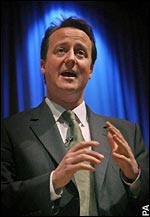
(David Cameron: 'The union is good for us all')

Britain wants UK break up, poll shows
By Patrick Hennessy and Melissa Kite, Sunday Telegraph
Last Updated: 1:29am GMT 27/11/2006


The United Kingdom should be broken up and Scotland and England set free as independent nations, according to a huge number of voters on both sides of the border.


A clear majority of people in both England and Scotland are in favour of full independence for Scotland, an ICM opinion poll for The Sunday Telegraph has found. Independence is backed by 52 per cent of Scots while an astonishing 59 per cent of English voters want Scotland to go it alone.

There is also further evidence of rising English nationalism with support for the establishment of an English parliament hitting an historic high of 68 per cent amongst English voters. Almost half – 48 per cent – also want complete independence for England, divorcing itself from Wales and Northern Ireland as well. Scottish voters also back an English breakaway with 58 per cent supporting an English parliament with similar powers to the Scottish one.

The poll comes only months before the 300th anniversary of the Act of Union between England and Scotland and will worry all three main political parties. None of them favours Scottish independence, but all have begun internal debates on the future of the constitution.

The dramatic findings came as Gordon Brown, the favourite to succeed Tony Blair as Prime Minister, delivered an impassioned defence of the Union at Labour's Scottish conference in Oban yesterday.

In an attack on the Scottish National Party, against whom Labour will fight a bitter battle for control of the Edinburgh-based parliament next May, the Chancellor claimed: "We should never let the Nationalists deceive people into believing that you can break up the United Kingdom."

The ICM poll told a very different story, however, with 60 per cent of English voters complaining that higher levels of public spending per head of the population in Scotland were "unjustified", compared to 28 per cent claiming they were justified. Even among Scots, 36 per cent said the system was unfair, with only 51 per cent supporting it.

Voters also had serious concerns about the so-called West Lothian Question, the ability of Scottish MPs at Westminster to vote on solely English matters while many purely Scottish issues are decided in Edinburgh. Sixty-two per cent of English voters want Scottish MPs stripped of this right and even 46 per cent of Scots agreed. The poll showed that the English are more likely to think of themselves as British than the Scots are. Only 16 per cent of English people said they were "English, not British", compared to 26 per cent of Scots who said they were "Scottish, not British."

In the sporting arena, 70 per cent of English people said they would support a Scottish team playing football or rugby against a nation other than England. But, when the question was put to Scots, only 48 per cent said they would back England with 34 per cent supporting their opponents, no matter which country it was.

There was good news for David Cameron, the Conservative leader, when voters in England were asked who they would back in a general election held tomorrow. The Tories were on 37 per cent, with 31 per cent backing Labour and 23 per cent supporting the Liberal Democrats.

Mr Brown said: "There is a debate to be had about the future of the United Kingdom. But I think when you look at the arguments — at the family ties, the economic connections, the shared values, the history of our relationship which has lasted 300 years — people will decide we are stronger together and weaker apart."

Mr Cameron said: "The union between England, Scotland and Wales is good for us all and we are stronger together than we are apart. The last thing we need is yet another parliament with separate elections and more politicians spending more money."

Sir Menzies Campbell, the Lib Dem leader, called for a "calm rational debate" on the role of MPs from Scotland, Northern Ireland and Wales at Westminster. "The last thing we need is knee-jerk opportunistic political responses."

Alex Salmond, the SNP leader, said: "In England, people quite rightly resent Scottish Labour MPs bossing them about on English domestic legislation. England has as much right to self government as Scotland does."


Post this story to: del.icio.us | Digg | Newsvine | NowPublic | Reddit

Related articles
Leader: United we stand
Tony Blair's lasting legacy could be end of the Union
Brown: We need to stick together more than ever
Bank on sporting support: for all England's rivals
The views from North and South
25 November 2006: PM attacks SNP's 'politics of grievance'
26 September 2006: Scottish question a threat to UK, warns Falconer

Wednesday, September 20, 2006

1000 YEARS OF CATALAN NATION. FREEDOM FOR CATALONIA. LIBERTY OF THE EARTH.

From: Josep <josepsort@mac.com>
Date: 20 setembre 2006 14:07:43 GMT+02:00
To: josepsort@mac.com
Subject: [josepsort] 9/20/2006 01:46:00 PM

POST TWOSPAIN WATCH:HOLOCAUST WAS LEGAL, YOU KNOW?
Currently Spanish Government is drafting a law to remember those who where killed by Franco’s regime. Among them there are thousands of republicans prisoners assassinated on the ground, others assassinated after being sentenced by court martials with no guarentees , and even those republicans exterminated at nazi camps, with the complicity of Franco’s regime.
(Right: Hitler-Franco meeting, 1940)It is interesting to know that there are more than 50.000 missing people buried somewhere. Most of them were republicans prisoners assassinated on the ground, with no trial, no defense. Massive graves have been localized in València, containing between 8.000 and 25.000 bodies, depending on sources. There are plenty of graves (containing 5,10, 16, 25 bodies) in forests, praires. Only few of them have been disclosed.Thousands of families have no idea where their relatives died, and where to go to honour their memory. These families were humiliated during the 36 years-long Franco’s regime, and the coming of the consitutional regime in 1978 implied no change, since it was built on a deal that include the renounce to prosecute francoist elements for the sake of “national reconciliation”. Even worst, the new regime renounced to know the truth. So there was no South-African style Truth Commission, where individuals accepted to publicly confess their crimes and reveal where to found their victims in exchange of judicial immunity.After years of silence and fear, now there is a growing demand to know the truth about the fate of fathers, grand-fathers, brothers, uncles that disappear with no trace. Some civic groups are pressing to approve a protocol in order to open graves and recover the remnants.In order to cope with this demand, current Spanish government has give a green light to the draft of a Law for the Historic Memory. This decision has raised a torrid debate among supporters and foes. Right wing vocals consider this Law a kind of revenge that breaks the founding rules of the current political regime. Supporters deny that claim. They consider that the Law only wants to restore dignity to both victims and their families, and that no charges will be brought."

It is interesting to know that there are more than 50.000 missing people buried somewhere. Most of them were republicans prisoners assassinated on the ground, with no trial, no defense. Massive graves have been localized in València, containing between 8.000 and 25.000 bodies, depending on sources. There are plenty of graves (containing 5,10, 16, 25 bodies) in forests, praires. Only few of them have been disclosed.Thousands of families have no idea where their relatives died, and where to go to honour their memory. These families were humiliated during the 36 years-long Franco’s regime, and the coming of the consitutional regime in 1978 implied no change, since it was built on a deal that include the renounce to prosecute francoist elements for the sake of “national reconciliation”. Even worst, the new regime renounced to know the truth. So there was no South-African style Truth Commission, where individuals accepted to publicly confess their crimes and reveal where to found their victims in exchange of judicial immunity.After years of silence and fear, now there is a growing demand to know the truth about the fate of fathers, grand-fathers, brothers, uncles that disappear with no trace. Some civic groups are pressing to approve a protocol in order to open graves and recover the remnants.In order to cope with this demand, current Spanish government has give a green light to the draft of a Law for the Historic Memory. This decision has raised a torrid debate among supporters and foes. Right wing vocals consider this Law a kind of revenge that breaks the founding rules of the current political regime. Supporters deny that claim. They consider that the Law only wants to restore dignity to both victims and their families, and that no charges will be brought.

But inside the supporters side there is not a common stand. Some of them consider that the draft avoids other hot issues, such as the demand to declare void all the death penalties sentenced by Francoist court martials. Drafters consider that these sentences were legal at the time, and as a consequence it is impossible to invalidate them. Of course this argument is false, since the defendant guarantees in those trials were almost inexistent.But this argument emphasizes something more important. Since the current spanish regime is the legal evolution of francoist regime –as you know there was no break up of dictatorship legality- we can say that Spain is the only country in the world where fascism has not been defeated by military means, like in Italy or Germany. So current government, pressed by powerful right-wing groups, including judiciary and media ones, renounces to clean spanish political system of any trace of fascist heritage. This behavior is unacceptable. Holocaust, the Final Solution, in nazi terms, was also legal in Germany at the time, but no one consider that current german legislators have to accept it, right? But Spain is (continues to be) different. --But inside the supporters side there is not a common stand. Some of them consider that the draft avoids other hot issues, such as the demand to declare void all the death penalties sentenced by Francoist court martials. Drafters consider that these sentences were legal at the time, and as a consequence it is impossible to invalidate them. Of course this argument is false, since the defendant guarantees in those trials were almost inexistent.But this argument emphasizes something more important. Since the current spanish regime is the legal evolution of francoist regime –as you know there was no break up of dictatorship legality- we can say that Spain is the only country in the world where fascism has not been defeated by military means, like in Italy or Germany. So current government, pressed by powerful right-wing groups, including judiciary and media ones, renounces to clean spanish political system of any trace of fascist heritage. This behavior is unacceptable. Holocaust, the Final Solution, in nazi terms, was also legal in Germany at the time, but no one consider that current german legislators have to accept it, right? But Spain is (continues to be) different.

Sunday, September 17, 2006

Crida d'aquest bloc: Envieu escrits en diferents idiomes.


També us voldria fer un prec, una recomanació . Tots els que sabeu escriure en francès, anglès o alemany caldria que fessiu escrits, cartes en aquests idiomes i els trametessiu a la premsa internacional o a aquest bloc "Catalonia next state" la finalitat del qual és internacionalitzar el nostre camí cap a la consecució d'un estat propi. "Cada Nació un estat"

Scots and Catalonia for Independence


Post 301 - Mals aires nacionals corrien fa 300 anys.
empordaaccio diumenge, 17 de setembre de 2006 21:17h

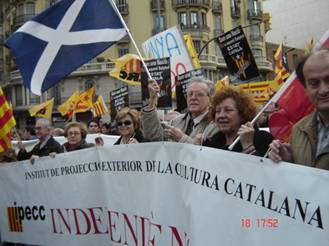
Fotografia adjunta: Delegació Catalana de l'IPEC a Escòcia, 2006. Porta la bandera escocesa n'Enric Garriga i Trullols, honorable patriota català, excel·lent lluitador, amic i germà d'Occitània i defensor de tots els Pobles d'Europa.

Mals aires nacionals corrien fa 300 anys perquè la reina d'anglaterra aplatofés el seu cul sobre la pedra dels escocesos.

Els independentistes escocesos es dupliquen
(Autogovern: Canvi de tendència al Regne Unit.)

(Tot és possible, malgrat els "delirium tremens" de tants Solanes, Maragalls i Pujols)

secessió · Un sondeig recent indica que el 44% dels ciutadans d'Escòcia desitgen separar-se del Regne Unit, mentre que un 42% prefereixen mantenir-s'hi units comicis · Les eleccions del maig al Parlament d'Edimburg posaran a prova l'SNP
C. R.

El suport a la independència d'Escòcia s'ha duplicat en el darrers anys, segons una última enquesta d'opinió. El resultat del sondeig és música celestial a les orelles d'Alex Salmond, líder del Partit Nacionalista Escocès (SNP). La pregunta a 1.200 escocesos sobre si, en cas que ara hi hagués un referèndum, votarien per una Escòcia independent o per seguir formant part del Regne Unit com fins ara, ha donat un 44% a favor de la independència; un 42% a favor de la unitat amb el Regne Unit; i un 14% que no té opinió sobre el tema. Els sondejos de la mateixa empresa publicats l'any 2000 per la mateixa publicació, The Sunday Times, donaven un 23% de suport a l'opció de la independència escocesa.
L'increment del suport al Partit Nacionalista Escocès és ara més rellevant que fa uns anys per la proximitat de les eleccions autonòmiques. El pròxim dia 3 de maig Escòcia votarà la formació del Parlament d'Edimburg, on ara els independentistes del Partit Nacionalista Escocès són la principal força a l'oposició. El líder escocès Alex Salmond explicava en una entrevista a l'AVUI (24-8-06) que si el seu partit guanya les eleccions del maig vinent convocarà un referèndum sobre la independència perquè, segons ell, "la independència no és un tema electoral ni de llei o decret". Salmond es mostrava prudent en l'entrevista recordant que en ocasions anteriors les previsions en les enquestes no s'han reflectit en els resultats electorals.
Escocesos il·lustres
L'últim sondeig, que dóna un 44% de suport a la independència, es va fer la setmana passada mentre el primer ministre, Tony Blair, i el ministre d'Economia, Gordon Brown, es barallaven pel lideratge del Partit Laborista. Els dos polítics laboristes són escocesos de naixement encara que només Gordon Brown representa un districte electoral a Westminster o manté lligams vitals a Escòcia. L'any que ve es complirà el 300 aniversari de la unió d'Escòcia i Anglaterra.
Brown es va presentar la setmana passada a Edimburg anunciant que serà al capdavant de la campanya electoral en les eleccions autonòmiques i advertint que "la unió ha estat beneficiosa per a Escòcia com ho ha estat també la devolution [la descentralització] que ha impulsat el govern laborista, que ha donat a Escòcia poders i competències per governar-se ella mateixa".
Les notes del Faroler són en cursiva en aquest post.

Els Escocesos oficialment tenen unió amb reconeixement de la seva naturalesa de "Nació" -seleccions nacionals, exèrcit ...-. Nosaltres durant quasi 300 anys sols hem tingut submissió i espoli en tots els àmbits! Ambdós, escocesos i catalans tenim dret, com tot Poble en el seu territori, a la plena sobirania.

(Sr. Pujol i senyors de Ciu, igual que Montenegro Escòcia i Catalunya tenen dret a ser i poden ser independents!)

Scots and Catalonia for Independence


Post 301 - Mals aires nacionals corrien fa 300 anys.
empordaaccio diumenge, 17 de setembre de 2006 21:17h

Fotografia adjunta: Delegació Catalana de l'IPEC a Escòcia, 2006. Porta la bandera escocesa n'Enric Garriga i Trullols, honorable patriota català, excel·lent lluitador, amic i germà d'Occitània i defensor de tots els Pobles d'Europa.

Mals aires nacionals corrien fa 300 anys perquè la reina d'anglaterra aplatofés el seu cul sobre la pedra dels escocesos.

Els independentistes escocesos es dupliquen
(Autogovern: Canvi de tendència al Regne Unit.)

(Tot és possible, malgrat els "delirium tremens" de tants Solanes, Maragalls i Pujols)

secessió · Un sondeig recent indica que el 44% dels ciutadans d'Escòcia desitgen separar-se del Regne Unit, mentre que un 42% prefereixen mantenir-s'hi units comicis · Les eleccions del maig al Parlament d'Edimburg posaran a prova l'SNP
C. R.

El suport a la independència d'Escòcia s'ha duplicat en el darrers anys, segons una última enquesta d'opinió. El resultat del sondeig és música celestial a les orelles d'Alex Salmond, líder del Partit Nacionalista Escocès (SNP). La pregunta a 1.200 escocesos sobre si, en cas que ara hi hagués un referèndum, votarien per una Escòcia independent o per seguir formant part del Regne Unit com fins ara, ha donat un 44% a favor de la independència; un 42% a favor de la unitat amb el Regne Unit; i un 14% que no té opinió sobre el tema. Els sondejos de la mateixa empresa publicats l'any 2000 per la mateixa publicació, The Sunday Times, donaven un 23% de suport a l'opció de la independència escocesa.
L'increment del suport al Partit Nacionalista Escocès és ara més rellevant que fa uns anys per la proximitat de les eleccions autonòmiques. El pròxim dia 3 de maig Escòcia votarà la formació del Parlament d'Edimburg, on ara els independentistes del Partit Nacionalista Escocès són la principal força a l'oposició. El líder escocès Alex Salmond explicava en una entrevista a l'AVUI (24-8-06) que si el seu partit guanya les eleccions del maig vinent convocarà un referèndum sobre la independència perquè, segons ell, "la independència no és un tema electoral ni de llei o decret". Salmond es mostrava prudent en l'entrevista recordant que en ocasions anteriors les previsions en les enquestes no s'han reflectit en els resultats electorals.
Escocesos il·lustres
L'últim sondeig, que dóna un 44% de suport a la independència, es va fer la setmana passada mentre el primer ministre, Tony Blair, i el ministre d'Economia, Gordon Brown, es barallaven pel lideratge del Partit Laborista. Els dos polítics laboristes són escocesos de naixement encara que només Gordon Brown representa un districte electoral a Westminster o manté lligams vitals a Escòcia. L'any que ve es complirà el 300 aniversari de la unió d'Escòcia i Anglaterra.
Brown es va presentar la setmana passada a Edimburg anunciant que serà al capdavant de la campanya electoral en les eleccions autonòmiques i advertint que "la unió ha estat beneficiosa per a Escòcia com ho ha estat també la devolution [la descentralització] que ha impulsat el govern laborista, que ha donat a Escòcia poders i competències per governar-se ella mateixa".
Les notes del Faroler són en cursiva en aquest post.

Els Escocesos oficialment tenen unió amb reconeixement de la seva naturalesa de "Nació" -seleccions nacionals, exèrcit ...-. Nosaltres durant quasi 300 anys sols hem tingut submissió i espoli en tots els àmbits! Ambdós, escocesos i catalans tenim dret, com tot Poble en el seu territori, a la plena sobirania.

(Sr. Pujol i senyors de Ciu, igual que Montenegro Escòcia i Catalunya tenen dret a ser i poden ser independents!)

Friday, September 01, 2006

FINANCIAL TIMES (Editor) (January 10 2006)


Hostage to Catalonia

Published:
January 10 2006 02:00 Last updated: January 10 2006 02:00

Most future historians will note with satisfaction that when Spain, three decades after the death of Franco and the supplanting of his dictatorship by democracy, was told by the commander of the Spanish army that the military might intervene if Catalonia was to get more self-governing powers, Spain was mildly shaken but far from stirred. General Jose Mena Aguado will go down in history as an anachronism.
The days of the military pronunciamiento are over. Spain is a confident and prosperous democracy inside the European Union, a cultural and economic powerhouse and an international citizen of standing. Its federal political system - despite tensions with the Basques and Catalans - must be accounted a success.
Yet in a speech last Friday Gen Mena referred to the Catalan regional government's plans to expand its powers as a repetition of pre-civil war history (he referred to the May 1932 debates on the Catalan autonomy statute). This is reactionary blackmail. Unhappily, the general is not entirely wrong when he claims Article 8 of the constitution empowers the army with defending the "territorial integrity" of Spain. Spain's democratic charter, passed in December 1978, contains flaws, recognised by many at the time. Article 8 was used by Francoist officers to justify their failed putsch of February 1981.
That era is over. But perhaps Spain's government(s) and people could usefully remind themselves of this. The government in Madrid, currently under Socialist management, is right to arrest Gen Mena. It intends to fire him, with the full support of the army chief of staff, and should make clear the same fate awaits any of his emulators.
The Catalan government - also currently led by Socialists - should tread with caution. It is within its rights to demand, for instance, tax-raising powers the Basques already have. Its demand that Catalonia be considered a "nation" reflects a cultural desire supported democratically by its people. This is not, per se, separatism; Article 2 of the constitution already recognises "nationalities" within Spain. Nor should its demand for greater judicial autonomy cause alarm so long as the supremacy of Spain's higher courts remains paramount.
But the Catalans, who pride themselves on being more European than the rest of Spain, should remember the principles of European Union solidarity. These include fiscal transfers from richer to less well-off regions. Why should that be right within Europe but wrong within Spain?
Spain's constitution should also be amended to spell out the supremacy of civil over military power. Unfortunately, the opposition Popular Party, still unreconciled to its ejection from power after the Madrid bombings of March 2004, seems to think Gen Mena has a point. That could represent a greater threat to Spanish unity than Catalonia's autonomy ambitions.


SOBRE AQUEST EDITORIAL DEL FINANCIAL TIMES CALDRIA FER CARTES CONTUNDENTS PREEMINENCIA DEL PODER CIVIL .

De:
"LOSTER"
Data:
Divendres, Gener 13, 2006 8:26 pm
A:
"ATENEU ART i CULTURA"
Prioritat:
Normal
Rebut de lectura:
demanat [Enviar rebut de lectura ara]
Opcions:
Veure capçalera completa

Veure la versió per impressora Veure com a HTML Bloca origenBloca domini d'origen


Benvolguts companys i amics .


Sobre aquest editorial del FT que us adjunto en un arxiu word caldria fer cartes
a la premsa catalana i espanyola.


Caldria, d'entrada, agrair al diari anglès de la city de Londres que tingui una
ctitud oberta a la diversitat lingúística i cultural de l'Estat espanyol .

Caldria agrair al FT que entengui d'una forma tan planera el fet diferencial
català . Què Catalunya és una nació


Caldria agrair al FT que en moment d'involució a l'Estat espanyol es posicioni a
favor de la peeminencia del poder civil i per l'abolició immediata de l'article
8.1 de la Constirució espanyola.


Caldria argumentar, en aquestes cartes obertes a la premsa catalana i espanyola,
que el FT és molt més democràtic i catalanòfil que no pas tota la munió de
premsa , ràdio i televisió de l'altiplà .

Caldria argumentar que sembla que a l'Estat espanyol ens tornem a trobar en el
tardofranquisme com en els anys setenta del segle passat i que el PP sembla FN .


Fixeu-vos que en aquests moments, en relació amb la premsa internacional ( més
enllà del FT ), que sembla que em fet un viatge regressiu cap al passat, on hi
ha molts trets amb comú amb el programa de la TVE1 "CUENTAME ". A més sembla que
en crosta social més dura del PP torna la síndrome del . - Fuera Europa ¡
Hijos de puta. Expressió que va dir un personatge sinistre vestit en caçadora
gris en el reportatge de fa 30 anys de la darrera concentració franquista a
la Plaça de Oriente de Madrid .

També us voldria fer un prec, una recomanació . Tots els que sabeu escriure
francès, anglès o alemany caldria que fessiu escrits, cartes en aquests idiomes
i els trametessiu a la premsa internacional .


SALUTACIONS .

Thursday, August 31, 2006

Effective Catalonia


Effective Catalonia

Enterprise is risk, but without entrepreneurs a country does not advance. Catalonia progresses, not through politicians profiting from the money of others, but from thousands of businessmen risking their own money. Some businesses go very well and others not because it is the law of life to grow and decline. This dynamism, not natural resources which we not possess nor our own State which we also do not have, gives us our wealth and strength.In Madrid the word risk does not exist, because behind everything they always have the State: behind Iberia the gift of Terminal IV in Madrid or behind Endesa, the former PP electricity monopoly, which prefers to be in German than Catalan hands, as though Berlin were closer and more easily influenced than Barcelona. The Madrid entrepreneur lives off politics and bureaucracy. The Barcelona-Madrid shuttle has tried unsuccessfully to integrate Catalans in the Madrid economics because Catalans are viewed as suspiciously in Madrid as Jews were in Berlin when this was the capital of fascism. Catalan politicians -some to enrich themselves and if not ask Duran Lleida or José Montilla why both are multimillionaires if they have never worked- have copied the Madrid model. We have public companies like TV3, and staying in the same branch, private like Avui enormous loss makers, but certainly 100% servile. But Catalonia grows not through political pork barrel, but through entrepreneurs taking risks. Josep Jane Sola is a typical Catalan entrepreneur who founded his own dynamic bank, finally victim of a stock exchange crisis. He is also a well known economist, for many years president of the Catalan Economics Society, part of the Institute of Catalan Studies, where I was secretary until 2005 when Jose Montilla imposed Mr. X of GAL State terrorism, Narcis Serra, as president of socialist Caixa Catalunya which sponsors our Catalan Economics Prize. “Effective Economics” (Milenio, 2006) is the massive homage in two volumes, 1,466 pages and 116 contributors, which we economists dedicate to him. Dr. Jane shows me the front cover of himself as a young mountaineer and says that mountains teach about living: “The measured effort, the calculated risk, to reach the summit and, above all, to know how to get back.” In his dedication he writes: “The best secretary-collaborator I have ever had and what constant support and farseeing and unbreakable loyalty.” The Festschrift is promoted by Fabia Estape, of Port Bou by the way as his stormy mind shows, Juan Velarde Fuertes, Josep Vilarasau of la Caixa, and Jesus Timoteo, editor of the book with his son Oscar Jane. Populariser of economics and of the popular participation in the economy, he follows the observation by John Maynard Keynes: “What changes the world are not interest rates but ideas.” The effective economy is what makes the world go round. His model of an effective man is the inventor of the peseta Laurea Figuerola, born in the county of Anoia, in Calaf, and he in Igualada. He imposed the Catalan peseta eliminating the chaos of 97 Spanish coins. On the centenary of his death, February 28th 2003, we presented his book in homage. Apart from the peseta, he reformed foreign trade, freed education from the Church and even gave back Citadel Park from the military to Barcelona, something which present day politicians have still failed to do with Montjuic Castle, the other symbol of Franco-Spanish repression of Catalan freedoms. There is nothing that last longer than the provisional. A provisional, and liberal, government installed the provisional, and liberalising, peseta which lasted for 133 years. What is never provisional is proper work. What will remain of 23 years of Jordi Pujol, incapable of getting anything permanent for Catalonia? History will look more kindly on Josep Tarradellas, who found the way to force Madrid to break with the fascist past by restoring the Catalan government. He was a provisional president, in exile and after his return, but what remains is the return to legality, like what remains is the initiative of liberal entrepreneurs who reach the peak for an effective Catalonia.

Josep C. Vergés 27.8.06

---------------------------------


Opinions: La Catalunya efectiva
Dimecres, 30 d'agost de 2006 a les 14:00Informa: Joan
Política
L’empresa és un risc, però sense emprenedors un país no avança. Catalunya va endavant, no pels polítics aprofitant els diners dels altres, sinó pels milers d’empresaris arriscant els diners propis. Algunes empreses van molt bé i d’altres no tant perquè és llei de vida crèixer i caure. D’aquest dinamisme, no dels recursos naturals que no tenim ni d’un Estat que tampoc tenim, ve la nostra riquesa i força.A Madrid la paraula risc no existeix, doncs darrera sempre tenen l’Estat: darrera Iberia amb el regal de la Terminal IV de Madrid o darrera Endesa, l’exmonopoli elèctric del PP, que prefereix caure en mans alemanyes abans que catalanes, com si Berlin fos més a prop i influenciable que Barcelona. L’empresari madrileny viu de la política i de la burocràcia. El Pont Aeri ha intentat sense èxit integrar els catalans en el madrilenyisme econòmic, però els catalans som tan mal vistos a Madrid com ho eren els jueus a Berlin quan era aquesta la capital del feixisme. Els polítics catalans -alguns per enriquir-se i si no pregunteu Duran Lleida o José Montilla per què són els dos multimil.lionaris si mai han treballat- han copiat el model madrileny. Tenim empreses públiques com TV3, i seguint en la mateixa branca, privades, com Avui enormement deficitàries, aixó sí 100% servils. Però Catalunya no creix per les menjadores dels polítics, sinó pels empresaris que arrisquen. Josep Jané Solà és l’empresari típic català que crea el seu dinàmic banc, víctima final de la crisi borsària. També és un reconegut economista, molts anys president de la Societat Catalana d’Economia, filial de l’Institut d’Estudis Catalans, on jo era secretari fins que el 2005 José Montilla imposa el senyor X del terrorisme d’Estat dels GAL, Narcís Serra, a presidir la socialista Caixa Catalunya que patrocina el nostre Premi Catalunya d’Economia. “Economia efectiva” (Milenio, 2006) és el massiu homenatge, de dos volums, 1.466 pàgines i 116 col.laboradors, que li dediquem els economistes. El Dr. Jané m’ensenya la portada de jove excursionista i em diu que la muntanya ensenya a viure: “L’esforç mesurat, el risc calculat, arribar al cim i, sobretot, saber tornar.” En la seva dedicatòria m’escriu: “El millor col.laborador-secretari que mai he tingut i quin constant recolzament i clarivident i infragible lleialtat.” Promouen el Festschrift Fabià Estapé, de Port Bou per cert com mostra la seva ment atramontanada, Juan Velarde Fuertes, Josep Vilarasau de la Caixa, i Jesús Timoteo que ha editat el llibre amb el seu fill Òscar Jané. Popularitzador de l’economia, i de la participació popular en l’economia, segueix l’observació de John Maynard Keynes: “El que canvia el món no són els tipus d’interés, sinó les idees.” L’economia efectiva és la que fa girar el món. El seu model d’home efectiu és l’inventor de la pesseta Laureà Figuerola, nascut a l’Anoia, a Calaf, com ell a Igualada. Va imposar la pesseta catalana eliminant el caos de 97 monedes espanyoles. El dia del centenari de la seva mort, 28 de febrer de 2003, presentàvem el seu llibre homenatge. A més de la pesseta, reformava el comerç exterior, impulsava l’educació lliure (de l’Esglèsia) i fins i tot traspassava el Parc de la Ciutadella dels militars a Barcelona, cosa que no han aconseguit els polítics d’ara amb el castell de Montjuic, l’altra símbol de repressió franco-castellana de les llibertats catalanes. No hi ha res que duri tant com la provisionalitat. Un govern provisional, liberal, va instaurar la pesseta provisional, liberal, que ha durat 133 anys. El que no és provisional és la feina ben feta. Què quedarà de 23 anys de Jordi Pujol, incapaç d’aconseguir res perdurable per a Catalunya? La història mirarà amb millors ulls Josep Tarradellas, que va saber obligar Madrid a trencar amb el passat feixista restaurant la Generalitat. Era un president provisional, a l’exili i de retorn, però queda la recuperació de la legalitat, com queda la iniciativa dels empresaris liberals que fan el cim de la Catalunya efectiva.

Josep C. Vergés
27.8.06

Monday, August 21, 2006

Freedom and Independence for Catalonia !

From: Josep <josepsort@mac.com>
Date: 3 juliol 2006 03:53:36 GMT+02:00
To: josepsort@mac.com
Subject: [josepsort] 7/03/2006 03:30:00 AM

POSTS IN ENGLISH SERIE:


INTRODUCTION

This is the first post from a new brand serie i intend to publish in this blog. I have no idea if it will last. In principle, contributions to this serie will be monthly, but that is not an iron law. If necessary that will change, depending exclusively on my will.

The purpose of this serie is to address to those english readers unable to read in Catalan, that is the blog’s language. I won’t lose a second to introduce my national language. I think there are enough sources of information on it in English right now, so i recommend those interested to access them and get informed.

The serie content will consist in writing thoughts i have in order to inform my potential readers on issues related to Catalonia, not only from a political perspective, but also from many others perspectives.

Catalonia: Yeah, this is the nation that has as capital Barcelona, and also has FC Barcelona soccer team, Gaudí, Miró, Picasso i Dalí and much more attractions. I think that Catalan blogosphere, important as it is in relative terms, of course, lacks something really crucial: to link with the anglo blogsphere, that is the bigger in all terms. Most of Catalan written blogs (and also webpages) have no English version, as a consequence, surfers from the rest of the world have no clues on Catalonia and Catalan people. Even worst: they access to information about those issues provided by our enemies and adversaries. So there is a risk, i have detected of Catalan bashing. I think that most of this sapper task is carried out by people close or related to the spanish diplomatic network: cultural attachés, journalists, intelligence officers and so on. I have a few experience of how spanish consular officers try to silence any Catalan expression in a very important city of North-America, and i have enough. Since Catalan autonomous government has not a well established network of international representatives, powerful enough to counter those spaniard-driven attacks, most of them remain unanswered, and there is a risk that people interested in Catalan affairs got a biased information.

A secondary purpose in starting this serie is to write more often in English in order to upgrade my proficiency. If you, reader, cooperate in order to show my faults so as I can correct them, I will be very thankful.Now something about me. I’m 42, a political scientist teacher, male, white (i provide these data for sociological purpose only, and with no political intention whatsoever), and yes, of course, i’m a for the Independence of Catalonia (in this case, i provide this information with all the political intention). As a Catalan, I'm not consider myself as Spanish or Spaniard, so please do not treat me as such. It will be very offensive for me. So respect my choice and everything will be OK.Once introduced the blog purpose and shared some of my particulars, may be it’s time to read my first contribution.

--Posted by Josep to josepsort at 7/03/2006 03:30:00 AM

Saturday, August 19, 2006

free Catalonia - Catalunya lliure

free Catalonia - Catalunya lliure

www.independencia.cat
comunicacio@freecatalonia.com
Per col.laborar econòmicament:
Caixa Catalunya - Entitat: 2013 Oficina: 0011 Control: 31 Nº Compte: 0201448332


CATALONIA

Forward to freedoom

Probably you will have heard about

Antoni Gaudi's architecture; about the beaches of the Costa Brava; about the Eivissa parties; about the Barcelona F.C.; about the NBA player Pau Gasol; about the Valencian Falles; or about the struggle of this land to reach freedom.

The Principality of Catalonia, the Valencian Country, and the Balearic Islands form the Catalan Countries, where you are now - territories under the Spanish state administration -, and the North of Catalonia - in the French state.

We offer you the opportunity of briefly knowing some of our history. The history silenced by Spain. You are now in a country that has been fighting for centuries for its rights and freedom.

Welcome to Catalonia.

Catalan Countries

Catalonia's size is 69.823 square kilometres, a land bigger than Albania, Belgium, Denmark, Holland, Luxemburg or Switzerland, among others.

In Catalonia live more than 11 millions of people.

The Catalan Countries are divided in sections by the Spanish state in three "regions": Principality of Catalonia (four provinces), Valencian Country (three provinces), and the Balearic Islands (one province). The North of Catalonia make up most of the Oriental-Pyrenees department in France. This department is part of the "Llenguadoc-Rosselló" region. As well in the North of Catalonia you can find Andorra, settled as a state as France or Spain.

The Senyera: Our Flag.

The symbol of the bars (the flag of the four bars) appears for first time on the weapons and the shield of Ramon Berenguer IV (XII century). It was a sign of nobility. But the country will take it slowly as its own until it became one of the first national flags, making/becoming the Catalan flag one of the oldest in Europe.
Its public exhibition has been persecuted and sanctioned by the different Spanish governments and Kings through the history.

The Estelada: the freedom flag.

The Estelada was born in 1928, and it is the flag that symbolizes the struggle for freedom. The blue triangle represents the blue sky of mankind and on its centre shines a white star that represents the longing for freedom for Catalonia to decide its own future.
In 1969 appears the estelada of the red star of socialist tendency.
Nowadays different organitzacions, collectives and political parties in the Catalan countries use both flags.

The Catalan language: Our language.

The Catalan language is a clear proof of our existence as a nation and one of the major cultural identities of our people. Our language comes from the Vulgar Latin and in the XII century was consolidated in the administration, literature and science.
During the ruling of Jaume I, the Catalan language started to expand all around the Catalan nation, from Salses to Guardamar and from Fraga to Maó, the geographical limits that compose the current Catalan countries. During centuries the Catalan language was the only private, public and official language of the whole Catalan nation.
As the Roman Empire disappeared the Latin language gave way to new languages, so that in the VIII century it is considered that new Romanic languages are born, among them the Catalan language.
Although Catalan has its origins there, it has been persecuted by the French and Spanish states through prohibitions, royal decrees, dictatorships, and governments that had a common and only target: to eliminate differences and to attempt the absorption of Catalonia into Spain and France.
Nowadays the official use of the Catalan language is shared with the Spanish language in the Catalan countries except the North of Catalonia, where it has no official status. In Andorra, the Catalan language has always been the only official language.
Even though its official status, the Catalan language is frequently attacked and according to the Spanish Constitution, its knowledge is only optional, whilst it is compulsory to learn/speak Spanish and French (in the North of Catalonia).

The history of the resistance.

In 1640 starts the "Segadors" War. Catalonia fights against the expansionist ambitions of France and the Castilian centralism and its presence in our country that was being used as an operations base. The war leads to the defeat of Catalonia and the signature of the Pyrenees Treaty (1659), according to which the territories of Rosselló, Conflent, Vallespir and Alta Cerdanya are conceded to France.

All those Catalan territories are left without any recognition or right.

Some years later, between 1707 and 1714, Catalonia goes to war against the Castilian king Felipe V of Borbon in the so-called Succession War. The defeat suffered by our past generations left to the absorption of the Catalan countries in the kingdom of Castile -now Spain - losing its freedom. Once the Spanish King Felipe V won the war, he went onto dictate royal decrees in the Valencian country, the Balearic Islands and the Principality of Catalonia by which the Catalan countries would be taken to a new time of deep and dreadful consequences for our political and cultural history. Our own juridical system was abolished, all the self-government institutions disappeared, the laws of Castile were imposed, the use of the Catalan language was banned in the official and public life and a long list of terrible measures were enforced with tyranny and repression, but that would never accomplish their target to destroy the language, culture and personality of the Catalan nation.

In 1939 the triumph of the coup d'état of the fascist general Francisco Franco leads again to the lost of the freedoms and institutions of the Catalan countries, which had been slightly recovered at the beginning of the thirties in the XX century. From 1939 to 1975 was carried out again a tough oppression against the Catalan culture and specially/ in particular the Catalan language.

The Catalan language disappeared from all the public organisms, its use was banned and it was also banned to teach it in schools. The cultural institutions of the Generalitat (autonomous government of Catalonia) were closed.

After a formal request by the dictator Francisco Franco, the democratically elected Catalan President, Lluís Companys, was captured and handed out to Spain by the Gestapo in summer 1940. In Madrid Lluís Companys was interrogated and savagely tortured. Finally the order to execute him was given and carried out in the Santa Eulàlia Fossar, Castle of Montjuic, Barcelona, 15th October 1940.

Our President gave his life with an example of patriotism and loyalty to Catalonia: barefoot, to be in contact with the Catalan land, he died shouting "For Catalonia!".

The persecution against anything that made reference to Catalonia was criminal and absolute, our anthems and flags were also banned. The libraries suffered "depuration" and the books written in Catalan were burned or confiscated, likewise were the archives. The Spanish language was imposed in all public services as the only language and the names of the people, associations, establishments, streets and cities were forced to change its name. The Catalan language could only be used in the family life, and those that showed any Catalan sign, or those that had been elected members of the Catalan government were imprisoned, assassinated or had to go into exile.

With regard to Catalonia, maybe you didn't know that....
...the Catalan flag -four red stripes on a yellow backdrop- is one of the oldest national flags in Europe...

..Catalonia was a free and independent country until 1714...

..the cruelty of Spain's misrule went as far as to expose the head of one of the leading Generals of the Catalan resistance -Josep Moragues- in a cage at the city gates for twelve years (1715-1727) to strike terror into the heart of Catalans...

....the Catalan language has been systematically persecuted and downstaged by Spanish governments since 1714..

...the first major bombing campaigns of civil population in Europe were suffered by the citizens of Barcelona (1714, 1843, 1938...), thousands of whom died....

....Modernist architect Antoni Gaudí was arrested and imprisoned for speaking in Catalan...
..Josep Sunyol, one of the Presidents of Barcelona Football Club, was shot without trial at Guadarrama (central Spain) by Franco's rebel troops in 1936...

..after the civil war, about 150,000 Catalans were imprisoned in concentration camps and makeshift prisons..

...in 1940, the legitimate President of Catalonia, Lluís Companys, was captured by the Nazis in Brittany, handed over to Franco's police, tortured and shot by a firing squad, being the only democratically elected President executed in Europe in the 40s...

..in Mauthausen concentration camp, thousands of Catalan democrat exiles were to die because Franco deemed them to be "republicans" and "separatists", and thus "not Spaniards"?...

.....Franco looted trainloads of official Catalan documents belonging to democratic institutions and bodies for their scrutiny by police who drew up lists of thousands of enemies to be eliminated. These documents were taken to Salamanca in 1939 and have not yet been returned, overtly flaunting UNESCO criteria in this area.....

during the Franco regime (1939-1975), 95,000 Catalan citizens were court-martialled for political "offences", 12,000 of whom were executed and a further 200,000 forced into exile...

..Amnesty Internacional, the UNO's special Committee against torture and the Council of Europe's Committee for the Prevention of Torture regularly report the practice of torture in Spain as well as the impunity with which Spanish officials act..

...Spain has been condemned for the torture of Catalan nationalists in 1992 and is being tried at the European Court of Human Rights. A former sentence of the same Court condemned Spain to compensate Catalan nationalists for having been tried without full rights...

..Since 1978 over 1000 Catalan nationalists have been detained by different Spanish police bodies, one of which -the "Guardia Civil"- is a military corps.....should the situation of Gibraltar with regard to Spain and Great Britain be reviewed, the situation of Catalonia with regard to Spain must also be reviewed because the Treaty of Utrecht has marked both these territories' destinies since 1714.

Self-determination, one right wished by the people but refused by the oppressors.

Catalonia has a natural, historical and political right recognised internationally to all nations: the right of self-determination. If the Catalan people decide to go further than the dependant autonomy, it is our right to constitute our own political and self-ruling institutions. The French and Spanish authorities have committed uncountable historical injustices, and in great measure lays here our moral base for the national independence of Catalonia. With the actual French and Spanish states Catalonia will always have its right to claim back its national freedom, fully licit and groundlessly refused.

Today Spain and France are considered democratic states in the international community, but does not mean that Catalonia lives in democracy. Neither the French or Spanish constitution recognises the right of self-determination. The right of self-determination it is an act by which the people decide their own political future. This right is situated above all laws or constitutions, and above of any institution. The same way that nobody, person organism or state, can refuse the right to life, it is also impossible to make people refuse the decision of its future in freedom.
It has not been allowed to the Catalan nation to decide its own future. It has been refused its right to have its own national institutions and have its voice heard internationally. The Spanish and French laws are imposed. The Spanish and French languages are imposed whilst the use of the Catalan language decreases everyday. It is refused our right to compete with our own team and under our own flag in sports, even thought we are internationally recognised as a strong sports influence.

We are many the Catalans that believe that it is necessary the recognition of Catalonia as a self-ruling people. Let the people decide freely their future of peace, and tolerance.

This is the reason why our separatist option is democratic. We want to have the right to decide to live entirely in freedom as an independent state, with fairness and solidarity.

Visitor, enjoy Catalonia.Welcome to a country, which goes towards its own freedom!

Blog Archive