Saturday, May 05, 2007

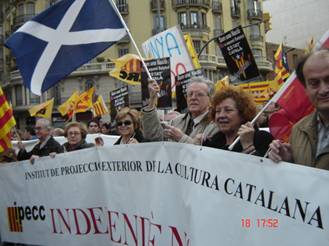
Scotland the next state in Europe ! ! !


The Spirit of Catalonia


• 2 •
Good Europeans


IT IS NOT SOUGHT HERE TO DESCRIBE IN DETAIL THE
social, political and military achievements of the Languedoc
people between the tenth and thirteenth centuries. I wish rather to
show the contribution made by that people to the development of
European cultural life, and the part it thus played in building up the
inner structure of our modern civilization.
As in all other European countries up to the twelfth century,
learning was confined to monastic centres, the most eminent being
the Benedictine monastery of Ripoll on the southern slopes of the
Pyrenees, consecrated in 888 at the suggestion of the count of
Barcelona, Jofre. There a group of learned monks were devoting
their time to the translation of Arabic manuscripts, with a special
interest in mathematical works. It was there that the monk
Gerbert—later Pope Sylvester II—spent three years, preparing his
great work on mathematics, and it is thought that it was the bishop
of Barcelona, Llobet, who translated for him the work of
Massahalla on the Astrolabe.1
The Benedictines of Ripoll had one of the first libraries of the Dark
Ages of which we know. This was a small number of books if we
compare it to the library which the Arabs had in Cordova, but
nevertheless one of the earliest Christian collections of scientific
works before the beginning of the renaissance of learning. The
titles are known to us because the catalogue has been preserved.2
At the close of the tenth century 240 volumes meant a very rich
scientific library, considering the depths of barbarism into which
Europe had relapsed. Through
20
The Spirit of Catalonia
Ripoll some part of the ancient Greek scientific tradition, preserved
by the Spanish Mohammedans, was reintroduced into Europe.
PROGRESS IN MEDICINE
Shortly before the consecration of Santa Maria de Ripoll, medical
teaching was started in the town of Montpellier. There, the
progressive medical knowledge of the Arabs and Jews of the
neighbouring Spanish State had given rise to a cultural centre of
Christians wishing to acquire the knowledge of the nearby
physicians.3 The great medical men of Mohammedan religion,
Averroes, Avicenna, Rhases, Avenpace, were made known to the
students of Montpellier, and thence their influence spread to the
heart of Occidental Europe. The fame of its medical men made this
town a great centre for medical treatment. Jaffé has published a
medical document signed in Montpellier in 11374 when Bishop
Adelbert of Mainz visited the school of Montpellier to listen to its
medical lectures. St. Bernard, in a well-known letter, tells of the
archbishop of Lyons who, on his way to Rome in 1153, fell ill and
requested to be transported to Montpellier, 'where he spent on the
physicians the money he had and that which he had not'.5 In
January 1181, William VIII, count of Montpellier, gave
authorization for any local or foreign doctor to teach medicine. In
1220 Cardinal Conrad granted a university charter to the Medical
Schools of Montpellier, saying in the preface to this document that
'for a very long time the profession of medical science has been
flourishing with great glory in Montpellier, from which it has
expanded its fruits over the world'.6 This is the text of the original
foundation charter of the University of Montpellier; it was
confirmed in 1239 by Pope Gregory IX. Among the great men of
this school, Ramon Lull and Arnau de Vilanova were the
21
Good Europeans
greatest in the thirteenth century, and Henry de Mondeville and
Guy de Chauliac in the fourteenth. Early in the fourteenth century,
Mondeville, a Norman by origin, taught in Montpellier the
Hippocratic belief in the healing power of Nature, but
unfortunately his influence was impeded by his own pupil Guy de
Chauliac, who in some respects made surgery overstep its right
path. During Chauliac's lifetime, Montpellier was still the
university town of the Catalans, and this explains why French
historians, such as Desbarreaux Bernard,7 believe that Guy wrote
his 'Grand Surgery' in Provençal or Catalan, and not in Latin as is
commonly assumed. Desbarreaux's conviction is founded on the
Vatican Manuscript,8 contemporary with Chauliac and written in
Catalan, which is probably the most ancient existing manuscript of
Guy de Chauliac's great book.
In 1349 the town of Montpellier was annexed to the crown of
France by King Philip VI. This had been expected to happen for
many years, and already in 1300 a new Catalan university had been
organized in Lleida, better known to modern foreign scholars by its
Castilian name of Lérida. Thus, Guy de Chauliac may be
considered the last great man to have been produced by that onetime
famous medical centre. He was a pupil of the 'medicus' of
Toulouse, Nicolau Català, as he himself tells us in his Inventari o
Collectori en la part Cirurgical de Medicina, and later he learned
medicine and astrology, if not directly from Arnau de Vilanova as
Nicaise thinks,9 at least from what remained of Vilanova's school.
When Arnau de Vilanova died in 1311, Chauliac was a mere boy
of twelve or fourteen years.
LANGUAGE AND POETRY
Toulouse may be regarded as another cultural centre of the
Provençal people, although in this case the whole
22
The Spirit of Catalonia
country had contributed, in varying degrees, to its development. In
the poetry of the troubadours human language proved once again
capable of expressing higher feelings, emotions and passions, as in
forgotten times. The idiom employed was no other than was used
in ordinary everyday life, but it was polished and amplified by the
poets. We still have evidence of the noble use of the common
language in the middle of the barbarous tenth century, for instance
the Provençal translation of the Latin poem of Boethius. This poem
has served as a basis for the studies of Older Provençal, together
with the religious poems of the Valdenses or Vaudois of the
eleventh century, and among many others from the twelfth century
the epitaph on the tomb of Count Bernard, which is believed to
date from the early part of it.10 Examining the most ancient of these
writings, one is surprised that, thoughout the thousand years which
have since elapsed, the forms of the Catalan language should have
undergone such small changes. The following few lines, taken
from the Boethius poem, from the Valdense poems, and from the
epitaph on Count Bernard may serve as examples of the surviving
power of the language:
Molt fort blasmava Boecis sos amigs
No credet Deu le nostre creador
Las mias musas qui an perdut lo cant ....
Breoment es reconta en aquesta Lyczon
De las tres leys que Dio donec al mon.
La premiera ley demostra a qui a sen ni raczon ....
(La Nobla Llyczon)
Assi jai lo Coms En Bernat
Fiel credeire al sang sacrat
Que semper pros hom es estat
Preguem la divina bondat
Qu'aquela fi que lo tuat
Posqua son aima aver salvat.
23
Good Europeans
Of the latter lines, only two words—tuat, 'killed' and credeire,
'believer'—are not current in modern Catalan; all the rest are in
common use, a few of them changed by one or two letters.
In the twelfth century, the Provençal tongue was so well developed
that, as early as the close of that century or the beginning of the
next, two grammars of Provençal had been written, the Donat
Provençal, probably a work of the troubadour Huguet Faidit, and
the Dreita manera de trobar of the Catalan Ramon Vidal de
Besalú, of whom Milà i Fontanals says that he was not only a good
grammarian but also a great man of letters and a critic in the
modern sense of the word.11 Thus we have, at the beginning of the
thirteenth century, defined and specified forms of expression, long
before French, Italian, Spanish, or English had any similar rules.
Ramon Vidal says that 'in all the countries of our tongue, the songs
in Lemousin enjoy a greater authority than those of any other
language', and thus introduced for the first time the name of that
region where Provençal was spoken, as a synonym of Provençal or
Catalan; in Spain, the inaccurate use of the term Lemosín for the
Catalan tongue is common even nowadays.
Whatever name we may give it, the fact remains that this language
in its early maturity was the first of the new Romance tongues to
give form and means of expression to the moods, fancies, feelings
and passions of the human mind of the Dark Ages. Bernard de
Ventadour, Raimon de Miravel, Bertrand de Born, Gaucem Faidit,
Folquet de Marseille, Alfons King of Aragon, Guillem de Bergadà
and Cerverí de Girona were among the most famous troubadours
of the twelfth and thirteenth centuries; their birthplaces are spread
over the whole of the area where Provençal was spoken. In later
days, Dante and Petrarch were followers of the troubadours; it
would be difficult to understand the whole value of their poetry
24
The Spirit of Catalonia
without knowing how much they were influenced by the poetry of
Provence. The popularity of Provençal in the days before Dante
was born was so great that St. Francis of Assisi sang his songs not
in his native Italian tongue but in pure Provençal, when singing
together with his companions the birds he began his new
evangelization through the power of love.12
It would be out of place to write here at length of the poems of the
troubadours; but an exception may be made of Bernard de
Ventadour, not only because of the high merits of his verse, but
chiefly because of his stay in England, when he accompanied
thither Queen Eleanor, the wife of Henry II. In 1152, Ventadour
went to Poitiers where Countess Eleanor of Aquitaine, recently
become Queen of England, was waiting to start on her royal
journey to her new home. Ventadour joined her court and was
present at the coronation of Henry in Westminster. He remained in
England for four years, living most of the time at the Royal Palace
of Bermondsey on the south bank of the Thames. During the first
two years of this period, he did not write a single poem; both in the
climate and in the society surrounding him he seems to have found
the change too great to keep his inspiration untouched. But during
the latter two years of his stay he wrote on the life of the England
of his time, an England seen through the eyes of a refined writer
and poet come from a country which was already moving towards
a superior conception of life.
It has been stated that society in the twelfth century was still in the
crude stage characteristic of the beginning of civilization; it was
due to Bernard de Ventadour and his Provençal fellow poets that
the world realized the distinction between love and lust, 'a
distinction which remained largely theoretical until some time
later, when nature made it a reality'.13 The troubadours were more
concerned with man than with mankind. Their unsen25
Good Europeans
suous love of flowers, birds and ladies contrasts very deeply with
that of preceding generations of our western ancestors. The
troubadours of the twelfth and thirteenth centuries laid the
foundation stone on which every newly-rising national community
of Western Europe was to build the structure both of its poetical
idiom and of its poetic inspiration. It would be an exaggeration to
say with Raynouard14 that Provençal—or as he calls it, Romane—
was for a time universally spoken in the Romanized lands; but it
seems certain that from Dante15 and Petrarch18 to Chaucer, as from
Joinville to Alfonso X of Castile, all the great writers and poets of
Western Europe were profoundly influenced by the words of the
Provençal poets. The kings of England also used this language; of
Richard the Lion-Heart, the following famous lines have been
handed down to us:
Ja nuls hom pres non dira sa razon,
Adrechament, si com hom dolens non;
Mas per conort deu hom farie canson,
Pro n'ai d'amics mas paure son lur don,
Ancta lur es si per ma rezenson,
Soi sai dos yvers pres ....
THE PROGRESS IN LAW
In 1060 the Count of Barcelona, Ramon Berenguer I, called
together his most notable subjects that they might provide his
country with a written law. This decision, unprecedented at that
time, must be considered the first determined effort to settle the
unstable society of the eleventh century under reasonable juridical
and moral principles. The work was so well done that the
codification known by the name of Usatges (Usualia) has since
been the basic law of the Catalan people, adapted, in successive
times, to new conditions. The first article of the old Usatges gives
information on the type of assembly
26
The Spirit of Catalonia
which promulgated the law. Nineteen men met under the
chairmanship of the Count: three viscounts, thirteen lords, and
three jurists. They worked together until the first compilation was
promulgated by the Count; though we know that this assembly in
itself was not a parliament, yet the basis and spirit of the future
Catalan Corts—or Parliament—were present in the law as it has
been in the assembly. The word Usatges makes it clear that the
code was a selection of rules established by custom, which those
leading persons considered worthy of preservation and
enforcement by written law. Among the most remarkable points
were the recognition of equality in the civilian rights of burgesses
and knights and the introduction of the humanitarian
Constitutiones Pacis et Treugae (Constitutions of Peace and Truce)
against the permanent state of violence that characterized the Dark
Ages. This 'Peace and Truce' was for the first time established by
the Church in Catalonia at the Council of Tologes (Rosselló) in
1041 and was afterwards also accepted by the majority of other
western nations;17 and as it had been promulgated first of all by the
Church of Catalonia, so the Catalan civil law was also the first to
enforce the Pax Dei and the Treuga Dei, whose moderating
influence on the customs of the times was one of the main causes
of the end of the Dark Ages.
It has been said of the Usatges that it is difficult to find another
juridical document of the Middle Ages which combines such high
dignity and such great sense of responsibility.18 Here in the middle
of the eleventh century, the legislative potestas, the juridical source
of power, the executive authority, the military power and the duties
of the Prince (referring particularly to the protection of, and fidelity
towards, his people of all ranks, from the nobleman to the most
humble citizen), had already been established in written law. The
Usatges laid down, one hundred and fifty years before the Magna
27
Good Europeans
Charta of King John, the foundation stone of an edifice which,
when completed in the thirteenth century, was to be the first
democratic structure of Europe. It seems an act of justice to
mention, together with the name of the Count of Barcelona who
promulgated the law, two other names, Count Ermengol of Urgell,
of the house so intimately linked with the past of Catalonia, and
Ponç Bonfill March the jurist, who between them gave the Usatges
their form. At that time Castile had also granted her burgesses
great freedom.
ST. OLAGUER
The grandson of Count Ramon Berenguer I gave a great impulse to
the development of the growing Catalan nationality. Ramon
Berenguer III was a good soldier and statesman in the modern
sense of the word. He expanded the boundaries of Catalonia to the
west by conquering from the Moors the town of Balaguer, and he
obtained the vassalage of the Balearic islands from the Saracens.
An even greater achievement was the extension of the sovereignty
of his house over Provence. As with all good princes of the preparliamentary
epoch, the best evidence of his statesmanship was
the selection of his private counsellor; the man Berenguer chose
was without doubt the best in the country. He was Olaguer, later
Archbishop of Tarragona, a model of Christianity (he has been
canonized by the Catholic Church); he was, besides, a man of
remarkable good sense, most suited to advise his Prince on
political and diplomatic matters. To Olaguer is due the restoration
of the old Metropolitan See of Tarragona; it was made equal to the
See of Narbonne, which had been for more than three centuries the
religious centre of the Provençal people.
Olaguer combined high moral virtues and deep religious faith with
a clear understanding of practical matters.
28
The Spirit of Catalonia
During his lifetime—in 1115—Catalans contributed to the first
great naval expedition organized against the Moorish kingdom of
Majorca in the Balearic Isles. Pope Pascal II preached a crusade,
and Pisans and Catalans joined to raise a navy of five hundred
ships under the leadership of Count Ramon Berenguer III. The
contemporary poem written by the 'Diacon of Pisa'19 calls Ramon
Berenguer III Dux Cataloniae, and nation Pyreneae his country.
As three centuries before, Provençals came in great numbers: the
Lord of Montpellier, the Viscount of Narbonne, the Lord of
Arles, the Barons of Rosselló, Béziers, Nimes and so on, led their
men under Ramon Berenguer III. From then up to the fourteenth
century, there were always men of Southern Gaul fighting side by
side with the Catalans in their conquest of new lands.
In 1127, Olaguer was charged by the Count of Barcelona to
negotiate the first commercial treaty between Genoa and
Catalonia. By this treaty, Count Ramon Berenguer III took under
his protection all Genoese ships, property and persons sailing into
the ports from Nice to Tortosa; the Genoese granted similar
advantages to the Provençal-Catalan people. For every ship
entering a Catalan harbour Genoa paid ten moravetins. We may
repeat that this aspect of the great Catalan Churchman St.
Olaguer deserves to be stressed, for from Olaguer to Lluis Vives
and down to the modern Balmes, we shall find in all outstanding
Catalans the same combination of lofty human ideals with
practical common-sense. It may, in fact, be said to be the most
striking characteristic of the Catalan people as a whole. By their
over-great fidelity to idealistic convictions, the Catalans have
continued through the centuries as an explosive and sentimental
people whose sudden and violent reactions have on occasion
caused surprise elsewhere; on the other hand, it must be ascribed
to the common-sense of the Catalans
29
Good Europeans
that they have survived the most adverse historical conditions so
that to-day, after having lost for more than two centuries the last
remains of their national existence, they nevertheless show in no
lesser degree than before the same twofold national qualities.
This may also explain why modern Catalonia has produced so
many great artists simultaneously with an advanced industrial
development.
In Provence, the manifestations of that same mentality persisted
for several centuries in spite of the initial harsh domination of the
French; thus, when the French Minister Colbert established
industrial centres in the north of France in the seventeenth
century, he was merely introducing in the north an old tradition of
the south; as early as the beginning of the fifteenth century no
fewer than twenty various factory centres were flourishing in
Provence.20 After the reign of Louis XIV, and even more after the
French Revolution, the concentration of economic power in the
north reduced Provence to an almost exclusively agricultural
country, with the exception of Marseilles and a few other places.
The other aspect of the Provençal character is eloquently
demonstrated by the many architectural and sculptural monuments
which still exist, especially by old monasteries and churches of
Romanesque style. It was in the area occupied by the peoples of
Provençal tongue that this Romanesque art flourished; and the
persistence of artistic creative power may be proved by the fact
that Cézanne and Mistral were Provençals. Centuries later, when
the Catalan counties of Rosselló and Cerdanya had been
incorporated into France, the Catalan genius gave, as an example
of the perpetuation of its ancestral characteristics, two great men
to France, Joffre, the Marshal, and Maillol, the sculptor.
30
SUMMARY OF THE FIRST PERIOD OF THE PROVENÇAL PEOPLE (EIGHTH TO
THIRTEENTH CENTURIES)
During these five centuries the vernacular language had taken
shape and been progressively polished. The boundaries of the
region occupied by the Provençal people were well defined and
their social, political, juridical and artistic development had
surpassed anything produced by the other Western people of
Europe in the early Middle Ages. Shortly before the end of this
period, the sovereignty of the House of Barcelona was recognized
by the feudal nobles of Provence. From Nice to Tortosa the same
flag was flying: four red bars on a golden field. This was originally
the ensign of the counts of Barcelona; later, it became the flag of
Catalonia, Provence, Aragon, and of all the peoples of Catalan
origin.21 From those times, too, dates the adoption of St. George as
the patron saint of the Catalans. In 985, Barcelona was raided and
taken by the Moors, who in their turn defended the town against
the Catalan army of Count Borrell. During this siege of Barcelona,
Count Borrell prayed for divine aid and invoked the chivalrous
figure of St. George of Cappadocia, who—so tradition maintains—
appeared to the Christian army and led it to victory. After
recovering the town, Count Borrell adopted St. George's Cross as
the emblem of Barcelona, and ever since, for close on a thousand
years, St. George has been the symbolic guide of the national spirit
of Catalonia.
In 1148 a Genoese army helped the Catalans of Ramon
Berenguer IV to expel the Saracens from the town of Tortosa; the
Genoese fought under the flag of Barcelona, and after the conquest
of Tortosa Ramon Berenguer IV is said to have bequeathed to the
Genoese the St. George's Cross of Barcelona.22 In 1198, the
Genoese are believed to have followed the new flag for the first
time.23 In the year 1200, King Pere II founded the military order of
St.
31
Good Europeans
George of Alfama—an advanced post situated in the no-man'sland
between Christians and Moslems in Southern Catalonia.2*
During the conquest of Valencia in 1238 Jaume I the Conqueror,
with two of the greatest noblemen of the Christian army, En
Guillem d'Aguiló and En Guillem d'Entença, defeated the Moors
by the guidance of the sainted hero.26 After the fall of the town of
Valencia, King Jaume, having dedicated the cathedral to the
Virgin Mary, ordered the first church of the town to be offered to
the veneration of St. George. The chapel of the Generalitat
(Government House) in Barcelona is also dedicated to the spiritual
protector of the Catalans. In 1348 Valencia declared St. George's
day a national feast; Majorca followed that example in 1407 and
Barcelona in 1456.
At a time when devotion to St. George was particularly strong in
Catalonia—for he had been chosen as protector of the Catalan
armies in their fight against the Moors— St. Iago (St. James) was
entrusted with a similar mission on the other side of the Iberian
peninsula. From the ninth century (the time of Alfonso III of
Asturias) the belief that the body of St. Iago had been found in
Galicia gave great spiritual authority to this saint, who for the
Portuguese-Castilian soldiers was what St. George was for the
Catalans.
During the centuries in which the destinies of Provence and
Catalonia were united under the rule of the Catalan princes, a pact
was signed in Cazorla—in 1179—between Alfonso VIII of Castile
and Alfons II of Aragon, by which spheres of expansion into
regions of the Peninsula still held by the Moslems were
determined. The Moorish kingdoms of Valencia and Denia,
immediately south of the area already occupied by the Catalans,
was to be a zone of Catalan dominion, whereas the Saracen
kingdom of Murcia, immediately south of the port of Biar, was to
be an area of Castilian conquest. This pact was a rectifi32
The Spirit of Catalonia
cation of a former one signed by Ramon Berenguer IV and Alfonso
VII of Castile—in Tudilén, in 1151—by which Murcia was
hypothetically awarded to Catalonia. We do not know the reason
which made Alfons II of Aragon agree to the alteration of the
Tudilén agreement, an alteration by which he renounced the
kingdom of Murcia and therefore lost a substantial territory, which
in the course of time might have become Catalan. The most
probable explanation is that Alfons was, in a way, a King of the
Pyrenees—he has been called Emperor of those mountains28—with
vast lands extending from the plains of Piedmont in Italy where the
Marquis of Busca recognized the sovereignty of the Catalan
dynasty in the time of Alfons II27 to not far from the coast of the
Cantabric Sea. He may therefore have considered sufficient an
expansion to the south of the Pyrenees which already extended as
far as the whole length of England. Another contributory factor
may have been the personal influence of Alfons' wife, Sancha of
Castile, an aunt of King Alfonso VIII of Castile. This treaty of
Cazorla and its loyal fulfilment by the immediate successors of
King Alfons II explain the relatively reduced Peninsular area
which has Catalan as its native tongue. Taken in conjunction with
the recognition in 1143, by Alfonso VII of Castile, of the
independent kingdom of Portugal in the west, the treaty decided
the permanent settlement of the various Peninsular peoples as it
has remained up to the present.
Another outstanding development of this period has already been
mentioned—the enthronement, as Kings of Aragon of the Counts
of Barcelona. From then on to the sixteenth century, all enterprises
abroad of the Catalans were to bear the highest title their prince
possessed, that is, King of Aragon. But the flag, the men, the
language and the spirit were the same as before— Catalan.
Marching into battle, the Catalan soldiers—
33
Good Europeans
those rough combatants of Sicily, Greece, Sardinia and Naples—
shouted the two words which symbolized both their spiritual and
their patriotic faith: 'Per Sant Jordi i Aragó' (For St. George and
Aragon). Aragon to them was not the poor and thinly populated
accretion of territory ruled by the Catalan kings, it was their own
country and traditions. And they proclaimed it in Catalan. At the
close of that period, even men from the Castilian part of Aragon
called themselves Catalans.28
Provençal elements, both directly from Provence and from
Catalonia, had contributed to the making of the original kingdom
of Aragon; this made the progress of Catalanization feasible and
constant. Moreover, the Catalan authorities, eager to carry on
this process of unification, carefully avoided friction with the
Aragonese. King Jaume I the Conqueror was said to have broken
the fetters which oppressed aristocratic and tradition-bound
Aragon.29 It was mainly due to the personal intervention of Vidal
de Canyelles, Catalan bishop of Huesca, that Aragon became
accessible to the Continental ideas which the Catalans had brought
from Provence.30 In every place where the armies of the Kings of
Aragon settled, Catalan was spoken—in the Balearic islands,
Valencia, and later in the parts of Sicily and Sardinia given them
for colonization.31 At the beginning of the Aragonese-Catalan
union, the Aragonese contribution to the common expansion
beyond the sea was very small; in fact, they had refused to take any
part in the expedition to Majorca in 1229, just as, years later, they
again opposed the conquest of Sicily, in 1282. But once the latter
expedition was on its way the Aragonese joined the Catalans and
fought side by side with them as people of a single nation. The
Catalans introduced into Aragon the civic dignity called Ciutadà
honrat (Honourable Citizenship) which was first awarded in
Catalonia and later introduced in Aragon and in the parts where the
Catalans settled.
34
The Spirit of Catalonia
Ciutadà honrat was a nobiliary title qualifying its owners to take
seats with the men of noble rank.32
Thanks to the advanced state of their industries, the Catalans had
many advantages, military and other. The old Catalan wrought
iron-work had acquired worldwide fame and was still used in many
parts of Europe; the great monumental grilles of Notre Dame of
Paris were made in 1250 by two craftsmen from Barcelona, Sunyol
and Blay, and in armour we find new devices used by the Catalans
years before they were applied by any other people in Europe.33
Towards the end of these five centuries of a destiny shared with
Provence, the name Catalan is found referring to all peoples of
Provençal tongue. Thus, the Provençal troubadour, Albert de
Sisteron, says: "Tell me which are better, French or Catalans, and
place me among the Catalans, the Gascons, Provençals, Limousins,
Auvergnats and Viennois.'3* In Marseilles, a typical Provençal
song is called 'Catalan song'.35 And modern Provençal writers use
'Catalan' as a synonym for the Provençal tongue.36
BIRTH OF CATALAN SEAMANSHIP
The activities of the Catalans on the seas are as old as their history.
The ancient Barcelona of pre-Christian times had dedicated a
temple to Neptune. When the national history of Catalonia began,
we find Ermengol, Count of Empuries, defeating a Saracen
squadron on the sea near the Balearic Isles, sinking many ships;
this happened in the ninth century. Later, Count Ramon Berenguer
armed a powerful fleet in 1115, and together with the Pisans
attacked and subdued Majorca in the following year (see p. 28). In
1118, the same Count crossed the Mediterranean, paying a visit to
Genoa and Pisa. This appears to have been the first exhibition of
35
Good Europeans
growing Catalan power; the contemporary biographer of St.
Olaguer tells us that the armament of this fleet was magnificent
and the number of sailors great.
In 1147, Ramon Berenguer IV in alliance with the Genoese
assaulted the town of Almería held by the Moors of Southern
Spain; he surrounded the town and attacked it from the sea. In the
meantime, the Saracens recovered Majorca; but in the time of King
Jaume I, under the leadership of Admiral Ramon de Plegamans,
the island was again invaded and finally retaken in 1229. When the
Moorish kingdom of Valencia was conquered, the same king
charged the people of Barcelona with the naval expedition; they
went with a great number of ships, as is related in the Chronicle of
Desclot. Since then, the maritime power of the Catalans continued
to grow, until they became the leading sea-power of the Western
World, a position they held from the middle of the thirteenth
century to the end of the fifteenth.

Monday, April 23, 2007

"The Spirit of Catalonia", 1.


"The Spirit of Catalonia", editat el 1946, que divulguem pels nostres lectors gràcies a la col·laboració de la família Trueta.


• 1 •
Astride the Pyrenees
THE ANCESTORS OF THE PEOPLE DEALT WITH IN THIS
book were Pyreneans, Iberians, Celts, Greeks, Romans and
Visigoths. They lived in the southern part of Gaul and northern
part of the Iberian peninsula: that is, the large area between the
Loire in the North, the Ebro in the South, the Alps in the East, and
the Cantabric Sea in the West. Its geographical nucleus was the
town of Narbonne, centre of the Roman administration for more
than five centuries; in the extreme South was the town of Tarraco,
the capital of the Roman province of Tarraconensis. Later, when
the barbarians of the North invaded the decrepit Roman Empire,
they made Toulouse—farther West—their capital.
As for the more remote ancestors of this people, we know that the
races which migrated from Africa, Europe, or Asia always spread
very evenly over the South of Gaul and the North of the Iberian
peninsula. In fact there was no geographical obstacle to their great
invasions; this calls for an explanation, since the reader may think
of the Pyrenees as a barrier between the middle and the southern
parts of the area with which we are concerned. The Pyrenees may
be divided into three sections: the centre of the range which is very
difficult of access, and the two sections at the ends with passes
open even in the coldest winter. Towards the Mediterranean end of
the mountains, there are four routes linking the plains on either
side. Iberians, Greeks, Celts, Carthaginians, Romans and Goths—
none of them were ever checked by the Mediterranean Section of
the Pyrenees; rather is it probable that the passes lured them on to
the plains
2
The Spirit of Catalonia
beyond. But the middle and most of the western section are
different: throughout history they have acted as a confining wall,
partly because the passes through them are few and difficult, but
principally because of the warlike nature of the Basques, who have
lived there from prehistoric times. The Basques, with the
mountains to aid them, stopped the Romans with that same spirit
with which, many centuries later, they fought Charlemagne's
army—a struggle which inspired the Chanson de Roland and other
poems. It would not be an exaggeration to say that the unique
topography of the Central Pyrenees has preserved to our own day
one of the few prehistoric human stocks in Europe; and it is to the
mountains that the Basques are indebted for the preservation of
many of their ancient characteristics, physical, mental, and moral.
The existence of the Basques all along the high ranges of the
Central-Western Pyrenees is mainly responsible for the clear-cut
difference between Frenchmen and Spaniards of today; as time
passed the Basques of the plains have been strongly influenced by
both, but most of the mountaineers have remained purely Basque.
This varying accessibility of the mountains has conditioned the
history of the Iberian peninsula and has made its inhabitants what
they are today. The simple view—which, like every simple
impression, tends to stick in our minds—that the areas represented
by modern France and Spain are well defined by nature, is
incorrect if applied to the inhabitants. And it is equally misleading
if applied to the climate and other factors of their environment; in
fact, climate and natural surroundings are very similar throughout
both areas north and south of the Pyrenees. Thus, it is only natural
that the older inhabitants of the zone between the rivers Ebro and
Loire and the Alps and the Cantabric Sea had very similar
characteristics. If anything, in ancient times the Ebro was
considered a better boundary than the Pyrenees;
3
Astride the Pyrenees
it was the frontier between the Carthaginians and the Romans,
and later between Christians and Mohammedans. In later days,
the southern limit of the zone occupied by this people was
displaced to the south of the Moorish kingdoms of Valencia and
Denia.
Much study has been devoted to the question of Greek influence
in the Western Mediterranean after the foundation of the
Phocaean colonies of Massalia—Marseille (seventh century
B.C.), Rhoda—Roses, Emporion— Empuries, and
Hemeroskopeion—Denia: Greek influence on the later
characteristics of the people was important even if it cannot be
compared to that of the Romans. The term “influence” means not
only the grafting of ideas and habits; it is used here rather in a
biological sense. The Greeks and particularly the Romans
moulded the people of this zone and imparted to them their own
characteristics to such an extent that the latter called a very large
part of that area 'Provincia', as it were par excellence.1 Later it
was named Septimania because the Seventh Legion was stationed
at Béziers, another of the great towns of Roman Gaul.
During the fifth century A.D. these lands were occupied by the
Visigoths, after being ravaged by the Vandals, Cimbris, Teutons,
and Ambrones. Of all the barbarian tribes the Goths—Visigoths
and Ostrogoths—were the most highly civilized, and the only ones
to be Christianized at that early date (though they adhered to the
Arian heresy), and to possess an alphabet adapted to their own
language.2 They were easily absorbed by the more highly
developed indigenous civilization, and after a relatively short
time, in spite of being the ruling aristocracy, they mixed with the
native population; the southern part of the country then changed
its name to 'Gothia', or land of the Goths. The Roman traditions,
laws and administration were so deeply rooted that for a time two
parallel ways of living developed side by side;
4
The Spirit of Catalonia
on the one hand we find the newly-imported aristocratic manners
of the leading families holding a personal power purely Teutonic
in nature; on the other, a persistency of the old Roman
Communes with their civilian intercourse. But both the new and
the old social systems were rapidly changing with the changing
times.
At the beginning of the eighth century, the stabilization of this
society was interrupted by the sudden arrival of more barbarians,
this time from North Africa. At the first blow they defeated the
Christian army in the south of the Peninsula, and the Saracens
spread, in the course of a year or two, almost to the northern
confines of the Peninsula without meeting any serious opposition
except for the courageous resistance of the people of Mérida. The
feature common to all the previous invasions was then repeated,
but this time there was something more, which had a telling
effect on the making of modern Spain. The population of the
Peninsula behaved in the following ways.
I. The Mediterranean people of the Tarraconensis emigrated en
masse to the north of Septimania as far as the region of central
France called Limousin. The easy crossing of the mountains now
became a source of deep terror. After the Mohammedans had
swamped without a fight almost the whole of the Iberian
peninsula, the old imperial town of Tarraco, proud of her ancient
prestige, tried to resist the invaders. After a bloody struggle it was
taken, levelled to the ground, and its inhabitants massacred. The
same fate befell Manresa, Casserres, Cardona, Ausona and
probably the Greek Empuries further north. This seems to have
been more than the rest of that part of the Peninsula could stand.
Barcelona and Girona were occupied without a blow, and the
towns and villages were abandoned by a great proportion of the
Christian population, who fled to Gaul.3 Only a few people,
probably almost all of them Jews, remained in
5
Astride the Pyrenees
Barcelona; they were the population which the Christians found
when they recovered the city ninety years later. We have some
knowledge of what these people felt when their city was
reconquered by the Christians: it seems they received the
newcomers as enemies rather than as brothers, which suggest that
very few if any Christians were among them.4
2. The Basque people behaved as they had always done: they
retired to their closed valleys in the mountains and continued the
fight, supported from behind the protecting barrier by the Basques
living on the northern slopes of the Pyrenees. They were never
conquered, and thus they viewed the Moors from a distance, but
with the same vigilance with which, in centuries gone by, they had
viewed the Celts and the Romans.
3. Near the Cantabric coast there runs a long range of high
mountains which orographically are a continuation of the
Pyrenees; and there, people from the south and centre of Spain,
especially aristocratic families, found refuge from the Moors.
With their backs to the sea—an impassable barrier to a people
who were not sailors— they continued the struggle in the
mountains, and at length they began to recover their lost lands in
a slow, southward movement known in Spanish history as the
'Reconquista'. This was completed almost eight centuries later,
when the Moorish kingdom of Granada fell in 1492.
4. The people of the Atlantic coast, it seems, either stayed where
they were or retreated to the north-west corner of the Peninsula.
They were mostly of Celtic origin and at the time of the Teutonic
invasions of the Peninsula they had been conquered by the Sueve
tribes. This region was called Galicia, and from its people on their
southward march there arose, well within the twelfth century, the
Portuguese nation. Even nowadays, Galicians and Portuguese
speak two derivative forms of
6
The Spirit of Catalonia
the old Gallego language. The affinity of the Portuguese and the
Spaniards has been recognized from early5 times. The diverse
behaviour of these Peninsular peoples at the time of the Moorish
invasion lies at the root of their ensuing diversity, which has
persisted almost unchanged throughout the vicissitudes of history.
The people sheltering in the Cantabric mountains—Castilians or
Spaniards —and those compressed by the Saracens into the northwest
corner of the Peninsula—Galicians and Portuguese —moved
in two parallel lines until they reached the southern limits of the
Peninsula. Thus the central and western parts were recovered by
their original populations or at least by people of the same stock
as the pre-Mohammedan inhabitants. The central people spoke
the rapidly evolving variety of Romance now known as Castilian
or Spanish; the people of the Atlantic lands spoke their Galico-
Portuguese language, as they do now. The Basques descended to
the plains where they had previously lived since prehistoric times,
and stayed there. They had recovered the country where their
ancestors lay buried, and there they have remained, in almost
exactly the same places, to the present day.
The reconquest of the lands deserted by the Christians of the
Mediterranean coast was undertaken by the people of Southern
Gaul. Once across the Pyrenees, the Moors had continued
northwards and taken Narbonne; their advance was at last arrested
when the Frankish Charles Martel, duke of Austrasia, defeated
them. The decisive battle was fought between Poitiers and Tours
in 732. From that day two simultaneous successions of attacks
compelled the Saracens to go back whence they came. One of
these was a movement of the Peninsular peoples only (Portuguese
and Castilian); the other had a Continental origin: Gallic,
Frankish, Gascon (see map on p. 7). This movement liberated
Narbonne in 759, and then, under the supreme command of Louis
'le Debonnaire',
7
Astride the Pyrenees
King of Aquitaine, and with soldiers from Aquitaine, Gascony,
Septimania, Burgundy and Provence,6 the Christian army crossed
the Pyrenees, and liberated Girona in 785—or shortly before—and
Barcelona in 801. Louis 'le Debonnaire' brought with him to the
newly liberated regions soldiers of the same origin and language,
customs and feelings, being united by a common purpose of a
religious and—if this may be said referring to people of the eighth
century—a patriotic nature. The newly-recovered parts were
placed under a common administration, and lands were given to
the soldiers, at first in a fief for life—benefici, and later in
perpetuity—aprisió.
8
The Spirit of Catalonia
Families from the northern side of the Pyrenees settled on the
southern slopes and in the valleys, and with them they brought the
ties which connected these lands more than ever before, this
linking again the populations from Nice and Limoges to Barcelona.
The newly-regained country was more than an expansion of
Southern Gaul; it was the melting-pot in which the regional
differences between the peoples of Southern Gaul were fused into
a national type. The language they spoke was closely akin to the
various dialects of Southern Gaul—all of them of a common
origin, and known as Languedoc, Provençal, or Limousin (see map
above); it had the advantage of preserving the most vivid
expressions from the various dialectal forms.7
9
Astride the Pyrenees
The people of Southern Gaul had, under the Romans and probably
also under the Goths, succeeded in preserving self-government,
their own laws and their own magistrature; Northern Gaul—the
parts later to be occupied by the Franks—did not obtain these
rights before the twelfth century.8 In the eleventh century the
citizens of the towns in which Langue d'Oc was spoken— in the
area commonly called Provence, although it is very much larger
than the Provence of today—constituted a separate social class
distinct from the nobility, from the clergy, and from the serfs. They
were called bourgeois, a term which occurs in the Catalan law
Usatges in 1060, in Carcassonne in 1107, in Montpellier in 1113,
and in Béziers in 1121; the towns nominated consuls for their own
government.9 Soon the bourgeois of the villages formed militias to
assist the armies of the nobility in their wars; this institution,
although modified by centuries, still exists in Catalonia under the
name of sometent. Narbonne was made the religious centre, and
Barcelona became the political pole around which the national
consciousness was forming. Aix-en-Provence, Montpellier and
Toulouse were the complementary focus from which light was
shed over science, art, and politics. Thus it may be said without
exaggeration that by the twelfth century a new civilization had
emerged in Europe, for the first time after the collapse of Roman
society. It had taken more than six hundred years, but this
laborious process of gestation was now completed, and humanity
began to move upwards again. All conditions for a prosperous life
were at hand: among them a fertile land favoured by one of the
mildest and most equable climates in Europe; a geographical
situation which made the country between the Ebro and the Loire
the link joining the North with the South and the Mediterranean
with the Atlantic; numerous wealthy cities, in which society
increasingly resembled the ancient Roman pattern; good
communications;
10
The Spirit of Catalonia
Mohammedan civilization developing in the neighbouring Spanish
State;10 a refined aristocracy which protected the Arts, and a rich
and energetic middle class composed of merchants and sailors,
which provided the sources of the nation's wealth. Commemorating
the Gothic domination on both sides of the Pyrenees, a large part of
that region in which the Langue d'Oc was later spoken was called
Gothia or land of the Goths, and according to some authorities it
was from this that the word Gothalaunia originated. An alternative
view is that it was derived from a settlement of people from the
Gallic Champs Cathalaunis. As early as the beginning of the
twelfth century, the name was used in its modern form, Catalonia,
though then applied almost exclusively to the southern side of the
Pyrenees. Thus Catalonia may be said to be the region where all
the various characteristics of the Provençals became concentrated
and, in many spheres, intensified.11
Unfortunately, the seeds of disintegration were also to be found in
this early Provençal society. Among them was corruption in the
monastic orders and religious hierarchies, which many were
allowed to join not for their conduct, piety or wisdom, but merely
as followers of a profession in which the poor could find
subsistence and the rich a source of power. Another danger for this
young society was the fact that many of the aristocrats soon
neglected the arts of war, preferring patronage of poets and singers
to the exercise of their military prowess against the
Mohammedans. This criticism however does not apply to the
people who were more directly under the rule of the counts of
Barcelona—the Catalans; they had to fight continually in order to
drive back the Saracens from the lands they had conquered at the
beginning of the eighth century. The preponderance of Troubadour
poetry in the northern part of the country over its southern part,
that is, of Provence over
11
Astride the Pyrenees
Catalonia, is probably due to the fighting kept up by the Catalans.
From the time of the reoccupation by the Christians of the country
from Narbonne to Barcelona, the feudal authority was held by the
kings of the Carolingian dynasty. But in the course of time their
authority dwindled to hardly more than a nominal fief, from which
the earls of Barcelona were freed at the end of the ninth century,
'from Narbonne to Spain', as the Gesta Comitum put it. Some
stigmata of the former dependency still remained in the names of
the coins and the dates of the official documents, which were
inscribed and dated
12
The Spirit of Catalonia
according to the reign of the kings of France. In 1112, the Count of
Barcelona became Duke of Provence by his marriage with Dolça
the heiress of that dukedom. This new authority of the House of
Barcelona, extending from Nice almost to the Ebro, marked a
further step in the growth of national consciousness among the
people of the Langue d'Oc (see map on p. 11). In books by
Provençal writers on this period, we find definite expressions of
gratitude to the House of Barcelona for the high development of
Provence under its rule.12
The authority of the House of Barcelona over Southern Gaul took a
more definite shape when, in 1137, the Catalan counts became
kings of Aragon by the marriage of Count Ramon Berenguer IV
with Petronella, heiress to the throne of Aragon.13 From that time
onwards, Provençal was a language not only suited for poetry but
generally spoken at a king's court as well. Toulouse, the great city
of the river Garonne and the only centre resisting the hegemony of
Barcelona, more and more came under its influence; at the
beginning of the thirteenth century its dependency was complete,
when the country was ruthlessly attacked by the Northern
Frenchmen, the descendants of the Franks who had conquered
Northern Gaul in the sixth century.14 The terrible struggle between
the people of Northern and of Southern Gaul marked the end of
Provençal nationality and cut asunder for ever the destiny of a
people hitherto joined as one unit: from that time on, the Pyrenees
have remained a frontier.
The superiority in wealth, culture and refinement of the people of
Southern Gaul roused the envy of the warlike and primitive French
of that time;15 but this alone would hardly have sufficed to disrupt
so large a country, without the causes of disintegration already
mentioned. I have stressed that the most powerful of all was the
state of the Church; but the type of remedy the people tried to
apply to it was even worse. Among an intelligent and
13
Astride the Pyrenees
hard-working people of deep religious feeling, the spectacle of
degenerate priests who practised simony and other irregularities
produced a demand for reformation of these abuses. Rome was
unable or unwilling to meet this claim, with the result that heresy
sprang from the criticism and depreciation of the monks and
priests, and also from the economic development of the
communities.16 It was a merchant from Lyons named Valdo who
principally carried the propagation of the heretical doctrine. His
preaching was not in many points in conflict with the Catholic
dogma; but among other striking doctrines he preached that
poverty was essential in order to carry the Christian Apostolate in
accordance with the will of our Saviour; he and his followers also
spread the belief that taking an oath was forbidden by God and
that, in consequence, no man was entitled to swear an oath to
another man. It will easily be realized that the acceptance of this
doctrine would have brought about a collapse of feudal society,
which was founded on the fief of obligation; and that it would
probably have caused very real harm to a society not as yet
sufficiently developed to be supported by the communities only.
The Roman Church fought the heresy with all her might, and
Valdo and his followers were excommunicated. One of the
excommunicated Valdenses called Duran—H. C. Lea, an authority
on that period, calls him the Catalan Duran of Huesca17 —having
repented of his heresy and returned to the fold of the Roman
Church, asked Pope Innocent III for authorization to organize a
new monastic order whose exemplary poverty, morality, and piety
would serve as a model of Catholic life. Duran's idea was not
brought to a practical realization when, in 1207 he first approached
the Roman authorities, but it was accepted and fully developed
some years later when the Order of St. Francis was founded. It was
probably considered out of place at a moment when religious war
was ravaging the lands of
14
The Spirit of Catalonia
Southern Gaul; the reformation of monastic abuses may have been
considered more proper when complete victory had been won by
the army of the French Crusaders. In fact the Crusade was
preached against another heresy known by the name of an Occitan
town, Albi, where the new sect had made many proselytes, and
from which the terms of Albigensian and Albigenses were derived
and applied to the new heresy and heretics. This heresy was not
very different from that of the Valdenses, but it seems to have been
more popular in character, deriving some influence from ancient
Oriental Manicheism. Unfortunately, most of the contemporary
documents have been lost, and very little reliable information has
been transmitted to modern times, among it the Cansó de Crozada
of Guillem de Tudela.18 However, we know that the common
people of Provence called the priests of the new religion the 'poor
brethren' and the 'bons homens' —an evidence of the exemplary
role claimed by the heretics.
One of the first steps taken against the ensuing religious anarchy,
which threatened the collapse of Catholic authority, was the
Council of Lombers in 1165, where the nature of the heresy and
the dangers of its propagation were defined.19 The followers of the
new religion seem to have been, in general, illiterate persons who
had no established system of faith; the word Albigenses was
applied to them for the first time during the crusade in 1208; a
contemporary description,20 says that 'the false prophets claim to
follow the life of the Apostles, praying without end, walking
barefoot, and praying on their knees seven times, night and day;
they do not allow the use of money and do not eat meat or drink
wine and are satisfied with simple food; they say that alms have no
moral value because nobody should be allowed to possess material
wealth; they refuse the practice of Holy Communion saying that
Mass is useless, and they declare
15
Astride the Pyrenees
that they are ready to die and to suffer the most severe punishment
for their beliefs. They claim that they can perform miracles. There
are twelve principals among them under the direction of one whose
name is Pons.' Only when the admonitions of Rome were
neglected, the great Pope and able politician, Innocent III—
Lothario Conti, a native of Rome—decided to intervene in a more
vigorous way by changing the highly placed hierarchies of the
Provençal Catholic Church, as they were suspected of weakness
towards their heretical fellow-countrymen. The Troubadour from
Marseilles, Folquet—the son of a Genoese family and great friend
of St. Dominic and of King Alfonso VIII of Castille—was made
archbishop of Toulouse, and most of the other Church posts were
given to clergy from France. The bishops of Narbonne (Berenguer)
and of Béziers were dismissed and their successors were 'newlyimported'
men.21 St. Dominic then played the decisive part. He was
a Castilian by birth, born in the village of Calaroga in 1170, near
the town of Palencia. His name was Domingo de Guzmán, and he
belonged to a noble family. In 1203, when accompanying the
bishop of Osma, Diego, to France he became convinced that an
urgent remedy had to be applied to the heresy of Southern Gaul; he
went to Rome and was delegated by Pope Innocent III to preach
against the heretics in Provence, where he remained from 1205 to
1215. This preaching is considered to have been the mission of
Dominic's life; he did his best to restrain the heretics from their
errors, but believing he had failed he suggested to the Pope that,
where preaching had been inefficient, repression and blows might
be more effective. The following words are taken from his last
sermon in Provence: 'For many years have I exhorted you in vain
with gentleness, preaching, praying and weeping. But according to
a proverb of my country, "where blessing can accomplish nothing,
blows may avail". We shall
16
The Spirit of Catalonia
rouse against you princes and prelates, who, alas, will arm nations
and kingdoms against this land . . . and blows will avail where
blessing and gentleness have failed.' St. Dominic's prediction was
to be fulfilled, to the misfortune of the Provençal people.22 From
that time the Order of Dominicans grew out of the little band of
volunteers who had joined Dominic of Guzmán. In 1214 the
nucleus of this institution was formed around Dominic and was
known as the 'Holy Preaching'. In 1215 the archbishop of
Toulouse, Folquet, established Dominic and his followers in a
house and church in Toulouse. Innocent III made the first
arrangements for the foundation of the 'Order of Preachers', but it
was not before Honorius III had succeeded him that the new Order
had full Papal recognition, in 1218. By 1222, the year after
Dominic's death, there were more than five hundred friars and
sixty friaries, divided into eight provinces spread all over Europe.
One peculiarity of the Dominican provinces was that they
followed the old geographic and administrative divisions of the
Roman Empire: that is, Italy, Hispania, Gaul, etc. Lyons, Limoges,
Reims, Metz, Poitiers, Orléans in France; Bologna, Milan,
Florence, Verona, Piacenza and Venice in Italy; Madrid, Palencia,
Seville and Barcelona in the Spanish peninsula; Oxford in
England; Friesach and Prague in the Holy Roman Empire, and
Cracow in Poland had Dominican friaries which as early as 1217
had sprung from the forty friars of Rome and the thirty of Paris.
The original idea of St. Dominic of combining blessings with
blows qualified his order in Spain in later days for the
administration of the Inquisition.23 But side by side with these
intolerant Dominicans, some of the most illuminating minds of the
Middle Ages emerged from this order, among them St. Thomas
Aquinas and Albertus Magnus.
From the national point of view of the Provençal people, the
intervention of St. Dominic and his Order was
17
Astride the Pyrenees
decisive; he gave to Rome, Paris and Toledo, the centres of the
Italian, French and Spanish States (Madrid has now taken the
place of her neighbour, Toledo), the means of coercion against the
intermediate Catalano-Provençal nation. Three centuries later, St.
Dominic's foresight was to be proved again when the complete
extirpation was attempted of the free remains of the Langue d'Oc
people, that is, of the Catalans.
Both the Soldiers of the Cross—the men of France—and the priests
appointed by the Pope or by the Pope's legates, acted with rude
expedition, not only against the heretics but indiscriminately
against all nationals of the civilized Provence, irrespective of age,
sex, or religion. The city of Béziers was defended by its
inhabitants; after being taken by the Crusaders, it was completely
demolished and the whole population, heretic and Catholic alike,
was massacred. Carcassonne, too, suffered terribly, and after it had
fallen into the hands of the French, the Catalan King Pere II
decided to intervene in order to stop the progress of the French
across his country. Pere II had shortly before helped to defeat the
terrible Almohades from Africa, who were a serious threat to the
Christian Kingdoms of Spain after the Moorish defeat of the
Castilian army of Alfonso VIII at Alarcos, in 1195. At the battle
of 'las Navas de Tolosa' in 1212, the combined armies of the
Basques under the command of their king, Sancho the Strong, the
Castilians under Alfonso VIII, and the Catalans and Aragonese
under Pere II, completely annihilated the large Moorish army; this
victory marked the beginning of the Mohammedans decline, from
which they never recovered.
King Pere, knowing that the invasion of his country bore only a
remote relation to the extirpation of an heresy but a very close
connexion with the imperialistic ambitions of the French,
summoned a large army and went to the help of Toulouse. In
Muret, a few miles from Toulouse,
18
The Spirit of Catalonia
King Pere's army was completely defeated by the small army of the
Crusaders under the command of Simon de Montfort (1213), and
in the middle of the fighting the King was killed. The disaster of
Muret marked the beginning of the partition of the Occitan lands
into two parts under two separate powers, French and Catalan for
some centuries and French and Spanish later. The Catalan
hegemony in Southern Gaul began to decline until, less than fifty
years later, the son of Pere II, King James I, signed the
renunciation of his rights to the lands of Southern Gaul, in favour
of the House of France. The treaty of Corbeil, signed in 1258, gave
France the shape it has preserved through history. It also made
Catalonia what it is. From those days, the common interests of the
now divided people have many times been opposed by the
conflicting ambitions of Catalonia and France; the Provençals, as
rivals of the Catalans, were encouraged by France to inhibit
Catalan expansion. But then, as now, Provençals and Catalans had
a similar outlook derived from their common origin and similar
environment. King Jaume I—called 'the Conqueror' because of his
military successes—was more than any of his predecessors a pure
type of the Provençal race. Son of the Catalan Pere II—known as
the Catholic, in spite of his support of the heretics—and of Maria,
Countess of Montpellier, King Jaume was born in his mother's city.
For that reason Montpellier was the only city which remained in
Catalan hands up to the middle of the next century. This also
explains why Montpellier was the university town of the Catalans
and why its incorporation into France in 1349 marked the end of
the great period of that model of a medieval university. The
superiority of Paris reduced Montpellier, in less than fifty years, to
the provincial condition in which it has since remained.

Saturday, February 24, 2007

"he supports Catalan literacy crusades and Catalan independence"


sbject: [josepsort] 2/24/2007 10:34:00 AM
http://josepsort.blogspot.com/

Tidle:

"Barcelona's right-back philosopher out to make world a better place"

Sid Lowe
Wednesday February 21, 2007
The Guardian

A crowd gathers in the sunshine at the Camp Nou, hoping for a glimpse of their heroes - a fleet of luxury cars pulling away to cheering and applause. A BMW here, a Mercedes there, a Hummer, a Ferrari, a Porsche or two ... and a van. Yes, a van. It is not your typical footballer's car, but then the driver is not your typical footballer.
Oleguer Presas rejects suggestions that he's different and is uncomfortable with labels. Sitting in the bowels of the Camp Nou while he explains his beliefs in a soft, thoughtful voice, it is apparent that facile descriptions do him little justice, but there's no escaping the fact that he stands out - and not just because of the beard. Instead, Oleguer stands out because he speaks out.

The Barça right-back is a committed campaigner, an economics graduate who contributes to cultural and political journals with carefully elaborated articles, he supports Catalan literacy crusades and Catalan independence, and dedicated the only goal of his career to a fourteen year old from Sabadell who had been arrested for protesting against the mayor. He is the author of a book called Camí d'Itaca (The Road to Ithaca), which deals with everything from the Franco years to the war on terror and even anorexia.
He is also the author of an article entitled De Bona Fe (In Good Faith), which was published in Directa, a Catalan social journal, and then in the Basque newspaper Berria. In the article, Oleguer questions the independence of the Spanish judiciary, using the ETA terrorist Ignacio De Juana Chaos as an example of the hypocrisy of the system. It is a system he distrusts, right down to its party political representatives, insisting: "No party represents me. I feel closer to civil society than political parties; the only thing they really want from the people is a vote every four years. That's not the democracy I believe in."

Oleguer's article was a reflection on the state of law and De Juana was just one example, but the fall-out was intense. He was portrayed as supporting a convicted terrorist with 25 deaths on his hands. The press attacked him, the former Bolton striker Salva Ballesta said he deserved "less respect than a dog turd", and boot sponsors Kelme dumped him. When Barça visited Valencia, he was whistled and booed with every touch.

Wouldn't it have been easier to keep his mouth shut? "Yes," he says softly, "but life isn't easy. If we want a better world, we all need to roll up our sleeves. It's easy to moan to your friends and then do nothing. The consequences I suffer are nothing compared to what many people go through. What did sadden me, though, was that most didn't actually read the piece. If people engaged in dialogue with intelligence and disagreed, then fine, but they didn't."

And yet Oleguer is realistic enough to recognise that snap judgements are inevitable, that the headlines would focus on De Juana. It is a product, he believes, of a world where superficial imagery triumphs over analysis in wave after wave of information. "I often ask myself why we went to war in Iraq, why people weren't more scandalised by it, why they didn't do more when polls said they were anti-war. That's one of the great questions. But we live in a society where the news is voracious," he says. "There are stories that are hugely important but within a week they're forgotten.

"For me, it's shameful that [Iraq] was destroyed. And now they say: 'Oh, actually, no, there weren't any Weapons of Mass Destruction after all but we're going to stay here a while because there's such disorder'. But, that disorder was created by you! It's clear that there are imperialistic, economic and strategic interests behind the war but the news moves on and everyone focuses on something else. We have to stop and reflect a bit on where we are going, about imposing a more sustainable type of development, with genuine cooperation."

But doesn't football serve the same function, could it not be seen as a modern day opium of the masses? One to which Oleguer contributes? "It is helpful to rationalise the game, but football does matter," he says. "Because people give it importance."

And for Oleguer, nowhere is that more significant than at Barcelona, the club that presents itself as a Catalan flagship, an anti-Francoist resistance force. Oleguer writes in his book that: "When Barcelona win the league, we become the Army of joy finally able to face up to [Franco's troops]. We imagine ourselves halting that pack of tanks, responding to their bullets with song, laughing in the face of the fascist ire."

It might sound far fetched, and Barça's history is far less clear-cut than the official version would have it, but at least with Oleguer there's no shallow lip service to the legend, no ¡Visca Barça, Visca Catalunya! Now, where's my cheque?. "For me, Barcelona is genuinely special," he says. "It is the invocation of a country, representing Catalan identity and culture. Barça was a conduit for a feeling when people could not express themselves and for me it's a dream to be here at such a successful time."


In Good Faith, by Oleguer Presas (translated by Sid Lowe)

Ignacio De Juana Chaos has spent the last twenty years in jail. Reduced according to the penitentiary rules put in place by the previous government, he had been condemned to an 18-year sentence for the crimes he committed. However he remains in jail on remand, pending the final resolution of the case which has been opened against him because of two articles published in the newspaper Gara. The high court [Tribunal de Audiencia Nacional] judged that in those articles, De Juana Chaos committed the crime of making terrorist threats and condemned him to 12 and a half years in jail. De Juana Chaos has decided to go on hunger strike in protest against that ruling and is prepared to take his protest to the ultimate conclusion [his death]. The State of Law [estado de derecho] - that phrase that has been repeated so many times you would think it was an advertising campaign - does not permit the death sentence nor life imprisonment. Likewise, there is no room for euthanasia. I will allow myself to be guided by good faith and will therefore presuppose that the State of Law has not stopped trusting in its own laws and still does not want to impose the death sentence or life imprisonment. Guided by that same good faith, I will assume that there is no political intention to make euthanasia legal. I will suppose, again guided by good faith, that the content of De Juana Chaos's articles is sufficiently explicit and unambiguous as to keep a man in jail, despite the risk that he may die there. I would like to believe that in the State of Law freedom of expression exists and that in this case, just as in the Egunkaria case or in the case of the actor Pepe Rubianes (to cite just two examples), there is sufficient evidence to try those involved. If that were not so, everyone would be protesting long and loud like they do when freedom of expression is denied in other countries, such as Morocco, Cuba or Turkey. Good faith obliges me to believe that in the State of Law, justice is equal for everyone, that political pressure has no part to play and that judicial independence really does exist; that when the Minister of Justice Lopez Aguilar announces, in reference to the De Juana case, that "the government will construct new punishments and sanctions to avoid such releases", those words have no influence on the judicial sentence. Actions speak louder than words, they say. Well, David Fernàndez in his book Crónicas del 6 y otros detalles de la cloaca policial, informs us of the following events: the ex-Civil Guard General and the man responsible for the horrors of Intaxaurrondo, Enrique Rodríguez Galindo, was condemned to 75 years in jail for the assassination of Lasa and Zabala but served just over four years, claiming health problems. Julen Elorriaga was also released for health reasons: condemned to almost 80 years in jail, he served just 3% of his sentence. After conning the whole of Spain, De la Rosa is able to enjoy a generous house arrest because of depression. Rafael Vera, condemned to 10 years in jail for the GAL-led kidnap of Segundo Marey, spent just eight years in jail for the same reason ... David, in his book, talks mainly about torture and torturers; about how the justice system seems to see different degrees of severity based not on the crime but the perpetrator of the crime; about how the media machine works so as to criminalize certain forms of dissidence and not others; of how the police create the evidence necessary to implicate people according to their political interests; of how the government does not want to know about the reports put together by the United Nations' special investigators on torture or even hear about organisations like Amnesty International, who have claimed that in this [Spain's] State of Law, torturing does take place. But now, on top of all that, it turns out that the attorney's office from the Audiencia Nacional has asked for the Egunkaria case to be dropped because, they allege, there is no proof. It turns out that, in November 2004, a court in Strasbourg condemned the Spanish state for "not investigating" the tortures denounced some twelve years earlier by 17 supporters of Catalan independence - it was necessary to silence discordant voices during the Olympic Games. It turns out that, in November 2005, Zapatero pardoned four policemen from Vigo who had been suspended and sentenced to 2-4 years for beating, insulting and humiliating the Senegalese citizen, Mamadou Kane. It turns out that Aznar had done the same in December 2000: 14 policemen convicted for torture were pardoned. One of them was a reoffender. It turns out ... ... that I do not know what to think. Too often the State of Law has dark spots which make me doubt. It smells of hypocrisy. And too much hypocrisy can make you lose that good faith.

--
Posted By Josep to josepsort at 2/24/2007 10:34:00 AM

Saturday, December 02, 2006

Internationalizing the Catalan Question


We, the Catalans, have made «all the papers of the rhymed comic» to attain the Independence of Catalonia, from to struggle with the arms in the hand until shares the Spanish nationalist trick of the regional Parliament of the Zoological: we have proved everything. But there is a little given aspect that it is the internationalization of the severe colonial situation that we suffer as Catalans.

Like always I make, I revise our history for finding antecedent of this lack. There is not many, but one of very important, that it scored a goal to the attempt at Spain of standing in the new international sphere that was born of the end of the World War II and of the defeat of the German Nazism, narrowly tied to the Spanish pro-Franco fascism. I place you in that transcendental fact with words of it Heribert Barrera:

«The United Nations Organization was born, practically, in the Conference about International Organization that met in San Francisco the 25 April of 1945 [...] The World War II was in the final stages but it still lasted [...] Unfortunately it was clear since the winners of the war did not have the minor intention of recognizing the representative institutions of Catalonia existing in the requirement. Therefore any Catalan participation or that memorable Conference that got together the representatives of 50 states, spread to all five continents, came off excluded; that he wrote up the draft of the Card of the United Nations, and that the most important was indisputably from all international conferences that until then had been celebrated. However, if it was impossible to participate in it, it was necessary at least to attempt that Catalonia was present there somehow. The honor of this attempt falls on the Delegation in the United States of the Catalan National Council, formed then by J. M. Fontanals, J. Ventura Sureda, J. Carner-Ribalta and J. A. Gibernau. The three first, performer in proper noun, as members of the Delegation, almost in the name of all the numerous Catalan entities constituted in America, that expressly they authorized them, and also how, he says its writing, ''in name of the people of Catalonia, the voice of which feels silenced'', sponsors of the applicant Conference were directed to the four states of showing and registering the Appeal to the United Nations.»

The 14 April of 1945 was the fourteenth anniversary of the proclamation from the Catalan Republic and the same date in which the «Three of the USA» signed the Appeal to the United Nations on Behalf of Catalonia. Forty years after I had the honor of shaking the hand of one of the signatories, Josep Carner-Ribalta, who went from USA, in his almost ninety years, in Catalonia on the occasion of the commemorative facsimile edition of that Appeal.

It is a very important document that all Catalans have to be made know, especially because, besides ruining the lie Spanish and of all what is said, it is a model to be to present again in the world the situation of the last colony that is still subjected to the decrepit Spanish empire: Catalonia.
I attach you (in the foot) the archive in format .pdf of the facsimile edition of 1985.

-------------------

Information from to: http://blocs.mesvilaweb.cat/bloc/5531

Monday, November 27, 2006

Scotland and England set free as independent nations.


http://www.telegraph.co.uk/news/main.jhtml?xml=/news/2006/11/26/nunion26.xml

-----------------------

(David Cameron: 'The union is good for us all')

Britain wants UK break up, poll shows
By Patrick Hennessy and Melissa Kite, Sunday Telegraph
Last Updated: 1:29am GMT 27/11/2006


The United Kingdom should be broken up and Scotland and England set free as independent nations, according to a huge number of voters on both sides of the border.


A clear majority of people in both England and Scotland are in favour of full independence for Scotland, an ICM opinion poll for The Sunday Telegraph has found. Independence is backed by 52 per cent of Scots while an astonishing 59 per cent of English voters want Scotland to go it alone.

There is also further evidence of rising English nationalism with support for the establishment of an English parliament hitting an historic high of 68 per cent amongst English voters. Almost half – 48 per cent – also want complete independence for England, divorcing itself from Wales and Northern Ireland as well. Scottish voters also back an English breakaway with 58 per cent supporting an English parliament with similar powers to the Scottish one.

The poll comes only months before the 300th anniversary of the Act of Union between England and Scotland and will worry all three main political parties. None of them favours Scottish independence, but all have begun internal debates on the future of the constitution.

The dramatic findings came as Gordon Brown, the favourite to succeed Tony Blair as Prime Minister, delivered an impassioned defence of the Union at Labour's Scottish conference in Oban yesterday.

In an attack on the Scottish National Party, against whom Labour will fight a bitter battle for control of the Edinburgh-based parliament next May, the Chancellor claimed: "We should never let the Nationalists deceive people into believing that you can break up the United Kingdom."

The ICM poll told a very different story, however, with 60 per cent of English voters complaining that higher levels of public spending per head of the population in Scotland were "unjustified", compared to 28 per cent claiming they were justified. Even among Scots, 36 per cent said the system was unfair, with only 51 per cent supporting it.

Voters also had serious concerns about the so-called West Lothian Question, the ability of Scottish MPs at Westminster to vote on solely English matters while many purely Scottish issues are decided in Edinburgh. Sixty-two per cent of English voters want Scottish MPs stripped of this right and even 46 per cent of Scots agreed. The poll showed that the English are more likely to think of themselves as British than the Scots are. Only 16 per cent of English people said they were "English, not British", compared to 26 per cent of Scots who said they were "Scottish, not British."

In the sporting arena, 70 per cent of English people said they would support a Scottish team playing football or rugby against a nation other than England. But, when the question was put to Scots, only 48 per cent said they would back England with 34 per cent supporting their opponents, no matter which country it was.

There was good news for David Cameron, the Conservative leader, when voters in England were asked who they would back in a general election held tomorrow. The Tories were on 37 per cent, with 31 per cent backing Labour and 23 per cent supporting the Liberal Democrats.

Mr Brown said: "There is a debate to be had about the future of the United Kingdom. But I think when you look at the arguments — at the family ties, the economic connections, the shared values, the history of our relationship which has lasted 300 years — people will decide we are stronger together and weaker apart."

Mr Cameron said: "The union between England, Scotland and Wales is good for us all and we are stronger together than we are apart. The last thing we need is yet another parliament with separate elections and more politicians spending more money."

Sir Menzies Campbell, the Lib Dem leader, called for a "calm rational debate" on the role of MPs from Scotland, Northern Ireland and Wales at Westminster. "The last thing we need is knee-jerk opportunistic political responses."

Alex Salmond, the SNP leader, said: "In England, people quite rightly resent Scottish Labour MPs bossing them about on English domestic legislation. England has as much right to self government as Scotland does."


Post this story to: del.icio.us | Digg | Newsvine | NowPublic | Reddit

Related articles
Leader: United we stand
Tony Blair's lasting legacy could be end of the Union
Brown: We need to stick together more than ever
Bank on sporting support: for all England's rivals
The views from North and South
25 November 2006: PM attacks SNP's 'politics of grievance'
26 September 2006: Scottish question a threat to UK, warns Falconer

Wednesday, September 20, 2006

1000 YEARS OF CATALAN NATION. FREEDOM FOR CATALONIA. LIBERTY OF THE EARTH.

From: Josep <josepsort@mac.com>
Date: 20 setembre 2006 14:07:43 GMT+02:00
To: josepsort@mac.com
Subject: [josepsort] 9/20/2006 01:46:00 PM

POST TWOSPAIN WATCH:HOLOCAUST WAS LEGAL, YOU KNOW?
Currently Spanish Government is drafting a law to remember those who where killed by Franco’s regime. Among them there are thousands of republicans prisoners assassinated on the ground, others assassinated after being sentenced by court martials with no guarentees , and even those republicans exterminated at nazi camps, with the complicity of Franco’s regime.
(Right: Hitler-Franco meeting, 1940)It is interesting to know that there are more than 50.000 missing people buried somewhere. Most of them were republicans prisoners assassinated on the ground, with no trial, no defense. Massive graves have been localized in València, containing between 8.000 and 25.000 bodies, depending on sources. There are plenty of graves (containing 5,10, 16, 25 bodies) in forests, praires. Only few of them have been disclosed.Thousands of families have no idea where their relatives died, and where to go to honour their memory. These families were humiliated during the 36 years-long Franco’s regime, and the coming of the consitutional regime in 1978 implied no change, since it was built on a deal that include the renounce to prosecute francoist elements for the sake of “national reconciliation”. Even worst, the new regime renounced to know the truth. So there was no South-African style Truth Commission, where individuals accepted to publicly confess their crimes and reveal where to found their victims in exchange of judicial immunity.After years of silence and fear, now there is a growing demand to know the truth about the fate of fathers, grand-fathers, brothers, uncles that disappear with no trace. Some civic groups are pressing to approve a protocol in order to open graves and recover the remnants.In order to cope with this demand, current Spanish government has give a green light to the draft of a Law for the Historic Memory. This decision has raised a torrid debate among supporters and foes. Right wing vocals consider this Law a kind of revenge that breaks the founding rules of the current political regime. Supporters deny that claim. They consider that the Law only wants to restore dignity to both victims and their families, and that no charges will be brought."

It is interesting to know that there are more than 50.000 missing people buried somewhere. Most of them were republicans prisoners assassinated on the ground, with no trial, no defense. Massive graves have been localized in València, containing between 8.000 and 25.000 bodies, depending on sources. There are plenty of graves (containing 5,10, 16, 25 bodies) in forests, praires. Only few of them have been disclosed.Thousands of families have no idea where their relatives died, and where to go to honour their memory. These families were humiliated during the 36 years-long Franco’s regime, and the coming of the consitutional regime in 1978 implied no change, since it was built on a deal that include the renounce to prosecute francoist elements for the sake of “national reconciliation”. Even worst, the new regime renounced to know the truth. So there was no South-African style Truth Commission, where individuals accepted to publicly confess their crimes and reveal where to found their victims in exchange of judicial immunity.After years of silence and fear, now there is a growing demand to know the truth about the fate of fathers, grand-fathers, brothers, uncles that disappear with no trace. Some civic groups are pressing to approve a protocol in order to open graves and recover the remnants.In order to cope with this demand, current Spanish government has give a green light to the draft of a Law for the Historic Memory. This decision has raised a torrid debate among supporters and foes. Right wing vocals consider this Law a kind of revenge that breaks the founding rules of the current political regime. Supporters deny that claim. They consider that the Law only wants to restore dignity to both victims and their families, and that no charges will be brought.

But inside the supporters side there is not a common stand. Some of them consider that the draft avoids other hot issues, such as the demand to declare void all the death penalties sentenced by Francoist court martials. Drafters consider that these sentences were legal at the time, and as a consequence it is impossible to invalidate them. Of course this argument is false, since the defendant guarantees in those trials were almost inexistent.But this argument emphasizes something more important. Since the current spanish regime is the legal evolution of francoist regime –as you know there was no break up of dictatorship legality- we can say that Spain is the only country in the world where fascism has not been defeated by military means, like in Italy or Germany. So current government, pressed by powerful right-wing groups, including judiciary and media ones, renounces to clean spanish political system of any trace of fascist heritage. This behavior is unacceptable. Holocaust, the Final Solution, in nazi terms, was also legal in Germany at the time, but no one consider that current german legislators have to accept it, right? But Spain is (continues to be) different. --But inside the supporters side there is not a common stand. Some of them consider that the draft avoids other hot issues, such as the demand to declare void all the death penalties sentenced by Francoist court martials. Drafters consider that these sentences were legal at the time, and as a consequence it is impossible to invalidate them. Of course this argument is false, since the defendant guarantees in those trials were almost inexistent.But this argument emphasizes something more important. Since the current spanish regime is the legal evolution of francoist regime –as you know there was no break up of dictatorship legality- we can say that Spain is the only country in the world where fascism has not been defeated by military means, like in Italy or Germany. So current government, pressed by powerful right-wing groups, including judiciary and media ones, renounces to clean spanish political system of any trace of fascist heritage. This behavior is unacceptable. Holocaust, the Final Solution, in nazi terms, was also legal in Germany at the time, but no one consider that current german legislators have to accept it, right? But Spain is (continues to be) different.

Sunday, September 17, 2006

Crida d'aquest bloc: Envieu escrits en diferents idiomes.


També us voldria fer un prec, una recomanació . Tots els que sabeu escriure en francès, anglès o alemany caldria que fessiu escrits, cartes en aquests idiomes i els trametessiu a la premsa internacional o a aquest bloc "Catalonia next state" la finalitat del qual és internacionalitzar el nostre camí cap a la consecució d'un estat propi. "Cada Nació un estat"

Scots and Catalonia for Independence


Post 301 - Mals aires nacionals corrien fa 300 anys.
empordaaccio diumenge, 17 de setembre de 2006 21:17h

Fotografia adjunta: Delegació Catalana de l'IPEC a Escòcia, 2006. Porta la bandera escocesa n'Enric Garriga i Trullols, honorable patriota català, excel·lent lluitador, amic i germà d'Occitània i defensor de tots els Pobles d'Europa.

Mals aires nacionals corrien fa 300 anys perquè la reina d'anglaterra aplatofés el seu cul sobre la pedra dels escocesos.

Els independentistes escocesos es dupliquen
(Autogovern: Canvi de tendència al Regne Unit.)

(Tot és possible, malgrat els "delirium tremens" de tants Solanes, Maragalls i Pujols)

secessió · Un sondeig recent indica que el 44% dels ciutadans d'Escòcia desitgen separar-se del Regne Unit, mentre que un 42% prefereixen mantenir-s'hi units comicis · Les eleccions del maig al Parlament d'Edimburg posaran a prova l'SNP
C. R.

El suport a la independència d'Escòcia s'ha duplicat en el darrers anys, segons una última enquesta d'opinió. El resultat del sondeig és música celestial a les orelles d'Alex Salmond, líder del Partit Nacionalista Escocès (SNP). La pregunta a 1.200 escocesos sobre si, en cas que ara hi hagués un referèndum, votarien per una Escòcia independent o per seguir formant part del Regne Unit com fins ara, ha donat un 44% a favor de la independència; un 42% a favor de la unitat amb el Regne Unit; i un 14% que no té opinió sobre el tema. Els sondejos de la mateixa empresa publicats l'any 2000 per la mateixa publicació, The Sunday Times, donaven un 23% de suport a l'opció de la independència escocesa.
L'increment del suport al Partit Nacionalista Escocès és ara més rellevant que fa uns anys per la proximitat de les eleccions autonòmiques. El pròxim dia 3 de maig Escòcia votarà la formació del Parlament d'Edimburg, on ara els independentistes del Partit Nacionalista Escocès són la principal força a l'oposició. El líder escocès Alex Salmond explicava en una entrevista a l'AVUI (24-8-06) que si el seu partit guanya les eleccions del maig vinent convocarà un referèndum sobre la independència perquè, segons ell, "la independència no és un tema electoral ni de llei o decret". Salmond es mostrava prudent en l'entrevista recordant que en ocasions anteriors les previsions en les enquestes no s'han reflectit en els resultats electorals.
Escocesos il·lustres
L'últim sondeig, que dóna un 44% de suport a la independència, es va fer la setmana passada mentre el primer ministre, Tony Blair, i el ministre d'Economia, Gordon Brown, es barallaven pel lideratge del Partit Laborista. Els dos polítics laboristes són escocesos de naixement encara que només Gordon Brown representa un districte electoral a Westminster o manté lligams vitals a Escòcia. L'any que ve es complirà el 300 aniversari de la unió d'Escòcia i Anglaterra.
Brown es va presentar la setmana passada a Edimburg anunciant que serà al capdavant de la campanya electoral en les eleccions autonòmiques i advertint que "la unió ha estat beneficiosa per a Escòcia com ho ha estat també la devolution [la descentralització] que ha impulsat el govern laborista, que ha donat a Escòcia poders i competències per governar-se ella mateixa".
Les notes del Faroler són en cursiva en aquest post.

Els Escocesos oficialment tenen unió amb reconeixement de la seva naturalesa de "Nació" -seleccions nacionals, exèrcit ...-. Nosaltres durant quasi 300 anys sols hem tingut submissió i espoli en tots els àmbits! Ambdós, escocesos i catalans tenim dret, com tot Poble en el seu territori, a la plena sobirania.

(Sr. Pujol i senyors de Ciu, igual que Montenegro Escòcia i Catalunya tenen dret a ser i poden ser independents!)

Friday, September 01, 2006

FINANCIAL TIMES (Editor) (January 10 2006)


Hostage to Catalonia

Published:
January 10 2006 02:00 Last updated: January 10 2006 02:00

Most future historians will note with satisfaction that when Spain, three decades after the death of Franco and the supplanting of his dictatorship by democracy, was told by the commander of the Spanish army that the military might intervene if Catalonia was to get more self-governing powers, Spain was mildly shaken but far from stirred. General Jose Mena Aguado will go down in history as an anachronism.
The days of the military pronunciamiento are over. Spain is a confident and prosperous democracy inside the European Union, a cultural and economic powerhouse and an international citizen of standing. Its federal political system - despite tensions with the Basques and Catalans - must be accounted a success.
Yet in a speech last Friday Gen Mena referred to the Catalan regional government's plans to expand its powers as a repetition of pre-civil war history (he referred to the May 1932 debates on the Catalan autonomy statute). This is reactionary blackmail. Unhappily, the general is not entirely wrong when he claims Article 8 of the constitution empowers the army with defending the "territorial integrity" of Spain. Spain's democratic charter, passed in December 1978, contains flaws, recognised by many at the time. Article 8 was used by Francoist officers to justify their failed putsch of February 1981.
That era is over. But perhaps Spain's government(s) and people could usefully remind themselves of this. The government in Madrid, currently under Socialist management, is right to arrest Gen Mena. It intends to fire him, with the full support of the army chief of staff, and should make clear the same fate awaits any of his emulators.
The Catalan government - also currently led by Socialists - should tread with caution. It is within its rights to demand, for instance, tax-raising powers the Basques already have. Its demand that Catalonia be considered a "nation" reflects a cultural desire supported democratically by its people. This is not, per se, separatism; Article 2 of the constitution already recognises "nationalities" within Spain. Nor should its demand for greater judicial autonomy cause alarm so long as the supremacy of Spain's higher courts remains paramount.
But the Catalans, who pride themselves on being more European than the rest of Spain, should remember the principles of European Union solidarity. These include fiscal transfers from richer to less well-off regions. Why should that be right within Europe but wrong within Spain?
Spain's constitution should also be amended to spell out the supremacy of civil over military power. Unfortunately, the opposition Popular Party, still unreconciled to its ejection from power after the Madrid bombings of March 2004, seems to think Gen Mena has a point. That could represent a greater threat to Spanish unity than Catalonia's autonomy ambitions.


SOBRE AQUEST EDITORIAL DEL FINANCIAL TIMES CALDRIA FER CARTES CONTUNDENTS PREEMINENCIA DEL PODER CIVIL .

De:
"LOSTER"
Data:
Divendres, Gener 13, 2006 8:26 pm
A:
"ATENEU ART i CULTURA"
Prioritat:
Normal
Rebut de lectura:
demanat [Enviar rebut de lectura ara]
Opcions:
Veure capçalera completa

Veure la versió per impressora Veure com a HTML Bloca origenBloca domini d'origen


Benvolguts companys i amics .


Sobre aquest editorial del FT que us adjunto en un arxiu word caldria fer cartes
a la premsa catalana i espanyola.


Caldria, d'entrada, agrair al diari anglès de la city de Londres que tingui una
ctitud oberta a la diversitat lingúística i cultural de l'Estat espanyol .

Caldria agrair al FT que entengui d'una forma tan planera el fet diferencial
català . Què Catalunya és una nació


Caldria agrair al FT que en moment d'involució a l'Estat espanyol es posicioni a
favor de la peeminencia del poder civil i per l'abolició immediata de l'article
8.1 de la Constirució espanyola.


Caldria argumentar, en aquestes cartes obertes a la premsa catalana i espanyola,
que el FT és molt més democràtic i catalanòfil que no pas tota la munió de
premsa , ràdio i televisió de l'altiplà .

Caldria argumentar que sembla que a l'Estat espanyol ens tornem a trobar en el
tardofranquisme com en els anys setenta del segle passat i que el PP sembla FN .


Fixeu-vos que en aquests moments, en relació amb la premsa internacional ( més
enllà del FT ), que sembla que em fet un viatge regressiu cap al passat, on hi
ha molts trets amb comú amb el programa de la TVE1 "CUENTAME ". A més sembla que
en crosta social més dura del PP torna la síndrome del . - Fuera Europa ¡
Hijos de puta. Expressió que va dir un personatge sinistre vestit en caçadora
gris en el reportatge de fa 30 anys de la darrera concentració franquista a
la Plaça de Oriente de Madrid .

També us voldria fer un prec, una recomanació . Tots els que sabeu escriure
francès, anglès o alemany caldria que fessiu escrits, cartes en aquests idiomes
i els trametessiu a la premsa internacional .


SALUTACIONS .

Blog Archive