VENICE,
Italy — During most of the last 1,200 years, this watery Italian city was a nation unto itself — powerful, prosperous and proud.
Now, many of its residents are convinced that their best shot at the future lies in turning back the clock.
Venice and the surrounding region, known as the Veneto, would be much
better off as an independent state again, uncoupled from Italy, a
growing number of people say. They're tired of paying billions of
dollars in taxes to
Rome, only to see the money frittered away on other, less productive parts of the country.
So this year, thousands of
Venetians signed a petition demanding a divorce from their fellow
Italians. A declaration of independence was delivered — by gondola, of
course — to regional officials, who are mulling over a possible
referendum on breaking away.
"We say we don't need Rome," said Lodovico Pizzati, an economics
professor who is leading the campaign. "We have our right of
self-determination."
His dream, of an independent Venice taking its place alongside other countries in the
European Union, may be unlikely. But it's by no means unique.
Secessionist movements, some serious, some quixotic, have sprouted across
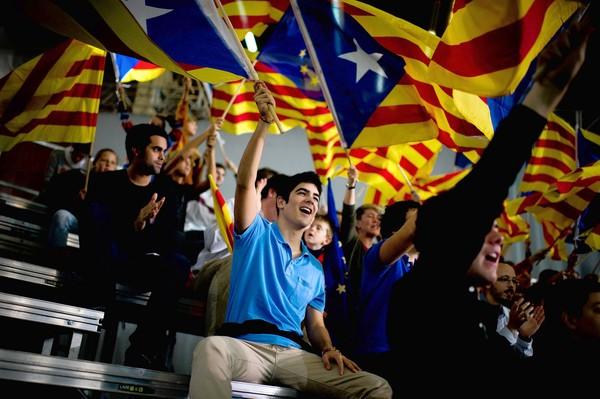
Europe. Scots will vote in 2014 whether to remain part of the United Kingdom or end Britain as we know it. Catalonians want out of
Spain. The Flemish are debating withdrawal from
Belgium.
Many of these movements are fueled by economic resentment, richer
regions eager to shake off poor ones as Europe battles a lingering
debt crisis and enacts draconian spending cuts. To critics, such discord makes a mockery of the EU and the harmony it's supposed to embody.
But a number of analysts contend that, far from pointing up its
failure, the various separatist movements actually attest to the EU's
success in bringing comity and stability to a continent torn apart by
two world wars, an achievement for which the 27-nation body this month
was presented the Nobel Peace Prize.
Under the EU's reassuring wing, it doesn't matter that an independent
Scotland or Veneto would each comprise only about 5 million citizens;
Denmark, a long-established club member, has about that many. The tiny
nations of Malta and Luxembourg, which belong not only to the EU but
also to the more exclusive group of 17 nations that use the euro, boast
only a million people between them.
In many ways, the European Union has created the very conditions that
now make independence for disaffected regions or minorities seem like a
viable option.
Virtually none of the secessionists talk about their homelands going
it alone, a brave new nation striking out on its own in the world.
Rather, their rallying cries of freedom for Scotland, Catalonia or
Flanders are invariably followed in the same breath by a description of
their aspiring country as a card-carrying member of a strong, durable
European Union.
They see the EU as a bulwark in an increasingly competitive,
globalized world. As a member of a club that wields immeasurably more
clout — financial, diplomatic, military — than they would have on their
own, small nations can thrive without fear of getting left behind or
trampled over, benefiting from the trade deals the EU wins on behalf of
all members or from its common foreign policy.
"The EU changes the equation," said Heather Grabbe, director of the
Open Society Institute, a Brussels-based think tank. "If you're looking
at the cost benefit of independence, having the EU there as the
guarantor of peace and stability, to some extent, and also providing
regulations and rules that you might need as a small state" can tip the
balance.
Because important EU decisions are made by consensus at high-level
summits in Brussels, separatists are beguiled by visions of their
leaders standing shoulder to shoulder with German Chancellor
Angela Merkel or sitting next to French President
Francois Hollande
at the negotiating table. Such egalitarianism was written into the DNA
of the European Union in reaction to the bloody wars of supremacy of the
20th century.
"The EU is dressed up as a community of countries that was
specifically designed to avoid the dominance of any one country," Grabbe
said.
Just how important remaining part of the EU is for breakaway regions
can be seen in the trouble they encounter if membership looks in doubt.
In Scotland, independence advocates have taken their biggest
political and public relations hit over signs that staying in the EU
won't be as automatic or simple a process as First Minister Alex Salmond
has consistently maintained.
There are no specific legal guidelines for what happens when an EU
member state splits up or a portion of an EU country secedes to become
an independent nation; this is virgin territory. But recent comments
from high-ranking EU officials suggest that newborn nations, even those
with an EU parent, would have to apply for membership like any other
aspirant country, a potentially laborious and protracted process.
This month, opposition lawmakers hooted in derision when Salmond's
independence-minded government was able to cite little more than "common
sense" in asserting that the EU would strive to make continued
membership for Scotland easy and pain-free.




 La
recent intervenció del rei Juan Carlos I davant l’Assemblea General de
l’ONU, lamentant la situació colonial de Gibraltar, té el seu origen en
el Tractat d’Utrecht (1713), amb motiu de la Guerra de Successió.


